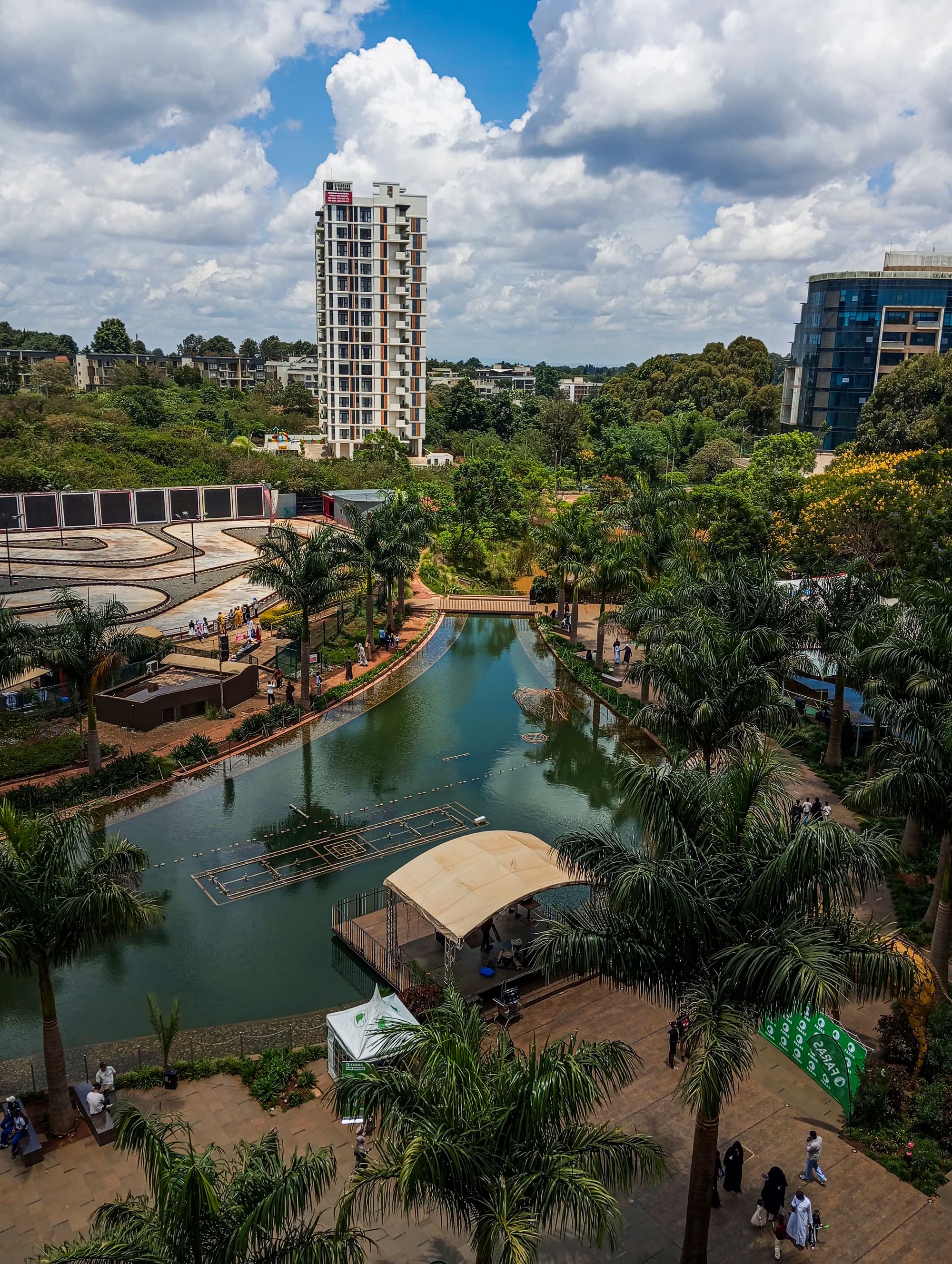
01What the memorial park actually is
The August 7th Memorial Park is a garden and memorial on Haile Selassie Avenue at Moi Avenue, a short walk south of the Kenyatta Avenue junction. It occupies the site of the 1998 bombing of the United States embassy, an event that killed more than two hundred people and injured thousands. The park is not a ruin and not a reconstruction. It is a deliberate piece of ground kept quiet, with the memorial wall, a garden, and a one-room museum that sets out what happened and who was lost. The park trust runs it as a place of remembrance rather than as a heritage attraction.
The site is on the list because it is the most serious ground in the centre and the quietest. The CBD around it is banks, towers, phone shops and traffic. The park is the opposite: enclosed, planted, and organised around reading and reflection. It is also one of the few places in the central business district where the history of the city since independence is presented directly, without a commercial frame. That combination makes it worth a deliberate stop rather than a glance through a gate.
Do not expect a large museum or a formal guided experience. The whole visit is compact: the wall, the garden, and the single museum room. The scale is the point. What is here is dense with names and testimony, and it asks for attention rather than for time. The park is ticketed, and the ticket is bought at the desk on arrival. The label on this site is Ticketed, and the suggested time is 45 min, though the museum rewards longer if you read everything.
02What there is to see and do
The park is arranged around four things, and the visit is a circuit rather than a route. The memorial wall carries the names of those killed in the bombing, and it is the centre of the site. Read it slowly. The wall is not decorative; it is the record, and it is the reason the ground was kept. The garden around it is planted and maintained, with paths and seating, and it functions as a garden in the ordinary sense: somewhere to sit in the middle of a loud city.
The one-room museum sets out the events of 1998, the response, and the aftermath. It is small by any standard, and the reading is short. Do not treat it as a passing pause. The room is where the context lives, and it is the part that turns the wall from a list of names into an account. The quiet is the fourth thing, and it is not a figure of speech: the park is noticeably still compared with the avenue outside, and that stillness is the reason people come back.
Photography is possible in the garden, but the wall and the museum are places to be careful with a camera. This is a memorial first. If you are coming to sit, the garden works. If you are coming to understand the 1998 bombing, the museum and the wall are the visit. The row list alongside this page names the four components. The park does not have a cafe, a shop or an events programme that a visitor can plan around, so the visit is the wall, the garden, the room, and the quiet.
The memorial wall
The names of those killed in the 1998 bombing are set into the wall that runs along one side of the garden. Read it slowly; it is the reason the ground was kept rather than rebuilt.
The garden itself
Planting, benches and shade on the footprint of the old Cooperative Bank building. Compared with the six lanes of Kenyatta Avenue a short walk north, the drop in noise is complete.
The one-room museum
A single room of photographs, testimony and recovered objects covering the bombing and the rescue. It rewards being read in full rather than skimmed, so allow time for it.
The quiet
There is no cafe and no shop, and nothing asks you to linger except the benches. The park works because it is empty of commerce, and that is the point.
03Reaching it from the Kenyatta Avenue grid
The park sits at Haile Selassie Avenue at Moi Avenue. From the Kenyatta Avenue junction with Moi Avenue, the walk is south and short: the distance from that corner is given as 0.31 km, or 4 min on foot. The route follows Moi Avenue down, with signalled crossings at the major junctions, and the park entrance is on the Haile Selassie Avenue side. If you are coming from further west along Kenyatta Avenue, walk east to the Moi Avenue junction first, then turn south. The grid makes this straightforward.
The walk itself is through the office quarter. Kenyatta Avenue has the widest pavements in the centre, with a planted median and bank frontages on both sides, and the pressure from hawkers that you meet further east is not an issue here. Moi Avenue is busier and more commercial, with phone shops and street trade, and the change in character is immediate. The park gate is a few minutes from the avenue, past the Haile Selassie Avenue junction, and the entrance is signed. On foot is the sensible way to arrive; the surrounding streets are one-way and congested, and parking in the CBD is its own exercise.
If you are coming from elsewhere in the CBD, the park is within walking distance of City Hall, the KICC and the Kenya National Archives on Moi Avenue. A matatu or taxi will get you there, but for a distance this short the traffic can make the ride slower than the walk. Agree any fare before you get in. The park is close enough to the Kenyatta Avenue spine that it can be added to a walk down the avenue without rearranging the day, and that is how this site would use it: one stop on a route that already includes the avenue and the archives.
04What to sort out before you go
This page is compiled from published information and the site's own checks rather than from a visit. Opening arrangements and anything that moves week to week are not printed here. The park trust sets its own opening days and hours and can change them for maintenance or for commemorative dates, so no hour appears on this page. The ticket is bought at the desk when you arrive. Before you commit to the walk down from Kenyatta Avenue, check the trust's current visitor information. If travel is being organised around the park, confirm before setting out rather than making the walk and finding the gate closed.
The museum is one room and the whole reading is short, so give it the time it asks rather than treating the park as a passing pause. Go in the middle of the day if you want the garden to yourself; it is quietest when the surrounding offices are at their busiest. The park is at Haile Selassie Avenue at Moi Avenue and is a short walk south of the Kenyatta Avenue junction, on signed crossings. Days and hours are set by the park trust and move with the calendar, so confirm the current arrangement rather than relying on any page, including this one.
The practical list alongside this page covers the same ground in shorter form. What it cannot do is give you a time to turn up, because the trust moves its days. What you can settle in advance is the shape of the visit: the park is ticketed, the ticket is at the desk, the museum is a single room, and the ground is small. If you are building the park into a longer walk around the Kenyatta Avenue quarter, put it at the point in the day when you want to sit down rather than at the point when you want to move fast. Check the current arrangement the morning you plan to go.
- The ticket is bought at the desk on arrival, so check the day's opening arrangement before you commit to the walk down from Kenyatta Avenue.
- The museum is one room and the whole reading is short: give it the time it asks rather than treating the park as a passing pause.
- Go in the middle of the day if you want the garden to yourself; it is quietest when the surrounding offices are at their busiest.
- Days and hours are set by the park trust and move with the calendar, so confirm the current arrangement rather than relying on any page, including this one.
- The park sits at Haile Selassie Avenue at Moi Avenue and is a short walk south of the Kenyatta Avenue junction, on signed crossings.
What this page cannot settle
The park trust sets its own opening days and hours and can change them for maintenance or for commemorative dates, so no hour is printed here. The ticket is bought at the desk when you arrive. Check the trust's current visitor information, and if travel is being organised around it, confirm before setting out rather than making the walk and finding the gate closed.
05Who it suits and the verdict
The park suits anyone with an interest in Nairobi's recent history, and it suits people who want a quiet half hour in the middle of the CBD. It suits travellers who are already walking the Kenyatta Avenue spine and want one stop that is not a bank, a mall or a monument to government. It also suits people who have a personal connection to the 1998 bombing, and the park is arranged with them in mind. The 45 min suggested here is a fair allowance; the visit can be shorter, but it is difficult to do it properly in less.
It does not suit anyone looking for a full museum, a guided tour, or an attraction with facilities. There is no cafe, no shop and no programme of events a visitor can plan around. It does not suit children as a day out, though older children studying the period will get something from the museum. It does not suit a rushed itinerary: the point of the place is that it is slow. If you are in the CBD for one hour and want to see as much as possible, the park will not fit, and this site would send that hour to the Nairobi Gallery on the avenue instead.
The verdict is straightforward. This is the most serious ground in the centre and the quietest, and it is worth a deliberate stop rather than a glance. Go for the wall, the single museum room and the garden, and go knowing that the ticket is bought at the desk and that the trust sets its own days. The park is a short walk south of the Kenyatta Avenue junction at Haile Selassie Avenue at Moi Avenue, which makes it easy to fold into a walk along the avenue. Treat it as the stop that changes the register of the day, not as one more item on a list.
Where this page comes from
Desk research, not fieldwork. Nobody writing this stood on the corner with a stopwatch, and a page that implied otherwise would be the least trustworthy thing on the site. The specifics above came from here:
- August 7th Memorial Park: the park trust’s own visitor information.
- Distances and walking minutes: computed from published coordinates, direct line at 4.8 km/h.
- Current travel advisories for Kenya: your own government’s published advice, which is updated and dated.
Opening hours, ticketing and market days change. No hotel or operator pays to appear here.
06Questions
Can I turn up without booking?+
The park is set up for people arriving on foot rather than for advance bookings, and the ticket is bought at the desk. That said, the trust controls its own days and can close the garden for maintenance or commemorative dates. Confirm the current arrangement before you make the walk.
How do I find it from Kenyatta Avenue?+
It is a short walk south of the avenue at the Haile Selassie Avenue and Moi Avenue junction, roughly 0.31 km and 4 min from the Kenyatta Avenue at Moi Avenue corner on the direct line. Every major junction on the route is signalled and the pavements are wide.
Is there much to see inside?+
There is a memorial wall carrying the names of those killed, a garden with benches on the building's footprint, and a one-room museum of photographs, testimony and recovered objects. It is small and serious. Read the room in full rather than passing through it.
What should I check before going?+
Check the park trust's current opening arrangement and the day's museum access, since the trust sets both and they move. Bring nothing special. The ticket is bought at the desk, and there is no cafe or shop on the ground.
Is it suitable for children?+
The garden is calm and walkable, but the museum content covers a bombing and its aftermath, so it suits older children and adults better than younger ones. The benches and the quiet make it easy to sit and explain rather than rush.