01Morning: history, before the heat
Start on Moi Avenue at the National Archives. It opens early by the standards of the centre, the Murumbi collection takes an hour without hurrying, and doing it first means walking the busiest pavement in the country before it reaches full volume.
From the Archives, walk west two blocks to the top of Kenyatta Avenue and the Nairobi Gallery in the old colonial court. It is small: half an hour, and it pairs with the Archives rather than competing with it.
09:00, Kenya National Archives
Ticketed, an hour. The photography rules are posted at the desk and enforced.
10:30, Nairobi Gallery
Ticketed, half an hour, at the Kenyatta Avenue end of the walk.
11:15, Biashara Street and City Market
Cloth, then the market hall. Bargaining in the upper gallery is expected and unhurried.
02Midday: the market quarter and lunch
Biashara Street and Muindi Mbingu Street are the shaded part of this walk, which matters between eleven and two at this altitude. City Market is free to enter, the produce trade is finishing by late morning, and the curio gallery upstairs is where the time goes.
Jamia Mosque is a block away on Banda Street and receives visitors outside prayer times, modestly dressed, by asking at the gate. Avoid Friday midday entirely. The McMillan Memorial Library is at the other end of the same street, and whether it is open depends on which phase of its restoration is running, so it is worth checking rather than counting on.
Eat on Standard Street or Kimathi Street with the office crowd from about half past twelve, which is when the kitchens are at their best and the queues are still short.
03Afternoon: the rooftop, then the park
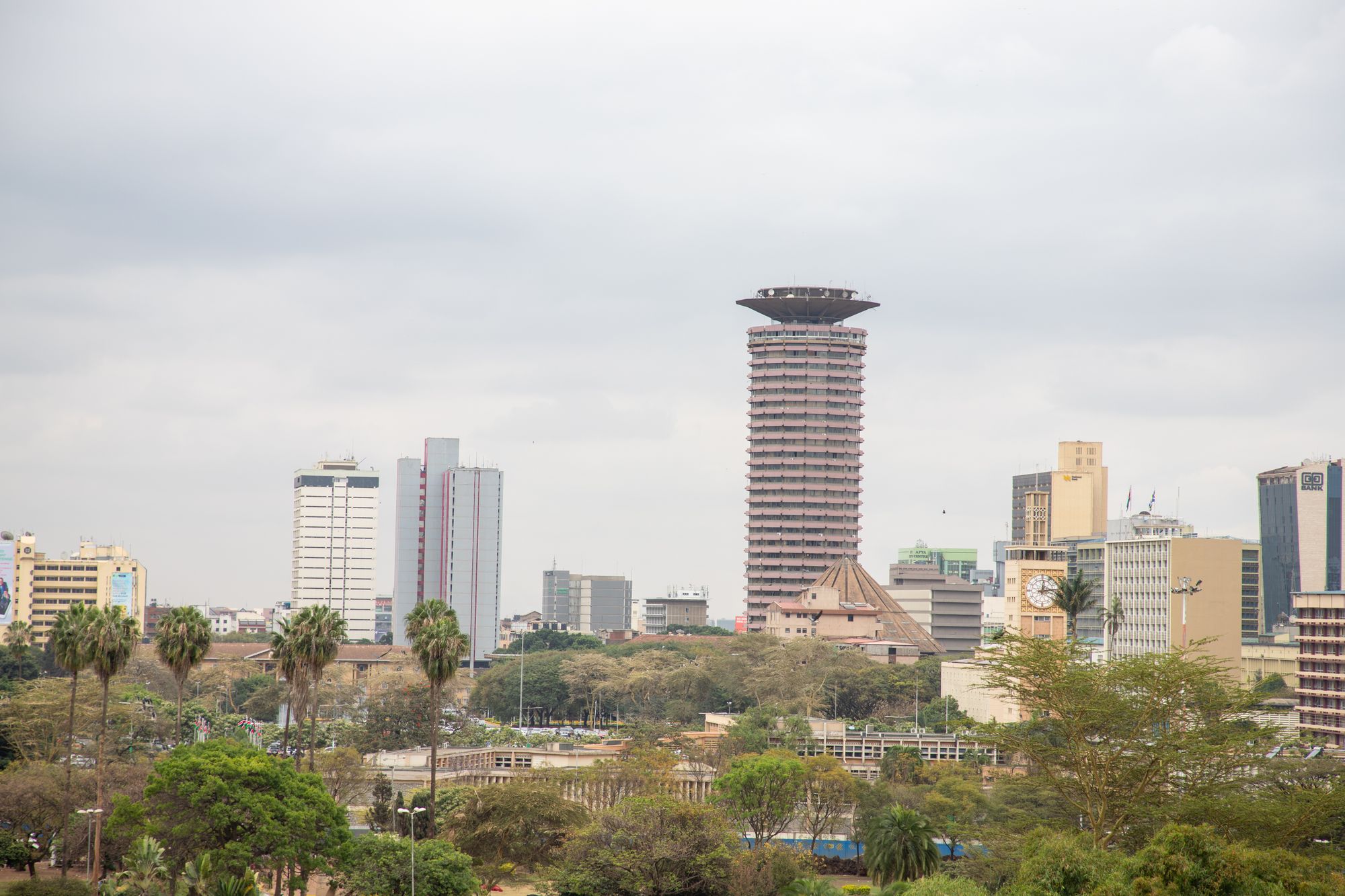
Walk south to City Square for the KICC. The rooftop deck is the one unmissable thing in the CBD: tickets at the ground-floor desk, identification asked for, and a lift most of the way up. Clear air is more likely in the morning, but the afternoon has the light on the towers.
Holy Family Basilica is directly across the square and open between services, which on a weekday afternoon means an empty hall for four thousand people.
Finish in Uhuru Park. Come in from the Parliament Road side, walk the lake, and take the skyline photograph from the eastern bank in the last hour of light. The gates close at dusk and that is enforced, so plan to be leaving rather than arriving at six.
The one rule for the evening
The CBD is not an evening district. Once the park closes, take a car: to a hotel restaurant on the avenue or the ridge, or west out of the grid. Walking the centre late is the single thing this site consistently advises against.
04Two variants
- If you would rather have markets than museums: start at six at the Ngara fruit market, walk down into the grid for City Market by ten, and give the afternoon to the KICC and the park.
- If you have a second day: the Railway Museum in the morning and the National Museum up Museum Hill in the afternoon, which are the two best hours of history the district has and do not fit into one day with everything else.
05When something on the loop is shut
The loop as written assumes five interiors open on the same weekday morning, and that is the optimistic version. Any one of them can be shut without warning: the KICC deck for a state event, the McMillan Memorial Library for whatever phase of restoration is running, the Jamia Mosque gate outside its visitor window, the Archives for a public holiday, the Nairobi Gallery between exhibitions. Treat a closure as the normal case rather than the exception and the day stops feeling like a failure. The fix is always the same: a substitute is within a short walk, and none of the substitutes costs the day anything.
If the Archives is shut, the Nairobi Gallery at the top of Kenyatta Avenue carries part of the same Murumbi material and takes about half an hour. If the gallery is also shut, walk west along the avenue to the bank halls and read the 1950s ceilings instead, then give the extra hour to City Market, where the produce trade finishes by late morning and the upper curio gallery absorbs as long as you let it. The market does not close for exhibitions and does not need a ticket. Between the gallery, the market and the avenue, a morning with a shut Archives still fills.
If the KICC deck is closed, the skyline photograph moves to Uhuru Park. The eastern bank of the lake frames the towers over the water and needs no ticket, no identification and no lift, and it is the same view from a lower angle. The deck can also close on the day for weather rather than for events. Ask at the ground-floor desk before committing to the lift queue, and if the answer is no, walk south and west to the park instead of waiting. Do the basilica across the square first, since it is open through the day between services and usually empty on a weekday afternoon.
If the McMillan Memorial Library is shut, Banda Street is still worth the walk for the Jamia Mosque end and the marble lions outside, and the reading room can be swapped for the bookshops along Moi Avenue, which keep ordinary shop hours and carry the best news stands in the city. If the mosque gate turns you away because the timing is wrong, come back another day or accept the exterior: three silver domes and twin minarets seen from the street are most of what a visitor is there for. Nothing on this loop is the only thing of its kind in the centre.
06The same day, run backwards
The reversed loop starts at the park rather than at the Archives, and it is the better call for anyone arriving in the middle of the day. The walk is then: Uhuru Park first while the light is still high and the gates are open, City Square and the KICC deck next, then west along Kenyatta Avenue to the gallery in the old court, then down into the market quarter for the late afternoon, and finally Moi Avenue and the Archives last if the Archives keeps an afternoon. The heat is the trade. The park at midday is open ground with little shade, and the market quarter is at its most comfortable in the middle of the day, which the forwards loop already exploits.
Reversing is the right call on a Sunday. The offices and banks along the avenue are shut, but the parks, the basilica and the KICC deck still work, and the market quarter runs on its own rhythm regardless of the office week. A Sunday reversed starts in the park, moves to the square for the basilica and the deck, and treats the avenue as a walking line rather than a place to do anything. The Archives may be shut, so leave it out and give the time to the gallery instead, checking beforehand. Sunday also brings the park at its fullest, with the boats out and the photographers along the lake edge.
Reversing suits anyone who lands late or who is staying on the western side near Uhuru Highway. Starting at the park end means the first walk is short, signalled and shaded on the avenue side, and the loop finishes in the shaded market streets rather than crossing the centre in the worst of the afternoon. The pitfall is the KICC deck, which closes in bad weather and can shut for state events without notice. If the deck is the reason for the day, do it first whatever the direction and build the rest around it. Everything else on the loop is substitutable; the rooftop is the one item this page would not leave to chance.
Reversing is worse on one count: the market halls shut in the late afternoon and the produce trade is a morning business, so a backwards day that reaches Biashara Street after the shutters come down has lost the best hour of the quarter. If the market matters, keep the forwards order and start early. If the rooftop matters more, reverse and take the deck in the middle of the day, when the light is flat but the queue is shorter. Decide which of the two the day is for before setting out, and the rest of the order sorts itself.
07What to drop when time runs short
Drop in this order, and drop without regret. First the Nairobi Gallery: it is half an hour of a small collection that pairs with the Archives rather than standing alone, and skipping it costs the day nothing that the Archives does not already give. Second the McMillan Memorial Library: restoration has moved its opening around for years, the walk down Banda Street is short, and the exterior lions can be seen in passing on the way to the mosque gate. Third the basilica if the deck is the priority, since an empty hall for four thousand people is impressive but not unrepeatable. Fourth Central Park, which is an extension of Uhuru Park rather than a separate destination, and which can be cut without losing the skyline view.
What never gets dropped: the KICC rooftop deck and Uhuru Park at the end of the day. Those two are the day. Everything else is negotiable. If only a few hours exist, do the deck first and the park afterwards and treat the interval between them as a walk down Kenyatta Avenue and through Kimathi Street rather than as a sequence of stops. That pair alone justifies the trip into the centre, and neither depends on a ticket desk being open at a particular hour except the deck, which is the one thing to confirm on the day at the ground-floor desk.
If only a morning exists, take the Archives and City Market and stop there. Those two are a short walk apart, both are indoors, and the combination covers the two things the centre does best: the colonial banking hall turned archive, and the 1930s market whose upper gallery sells what the streets below have traded for a century. Add the mosque gate only if the timing happens to be right. Anything further east or south is padding on a half day and turns a comfortable morning into a forced march through the heat with nothing gained for it.
For anyone who would rather shop than look, the order changes completely: the market quarter first, then Moi Avenue and Tom Mboya Street for the street-level trade and the news stands, then the Maasai Market rota wherever it has landed that day, checking the current day-and-place before setting out. The rooftop, the basilica and the park can all be cut from a shopping day without loss. The one fixed point is the market halls, which shut in the late afternoon, so the shopping version has to start in the morning and cannot be reversed.
Where this page comes from
Desk research, not fieldwork. Nobody writing this stood on the corner with a stopwatch, and a page that implied otherwise would be the least trustworthy thing on the site. The specifics above came from here:
- Opening arrangements: the National Museums of Kenya, Kenya National Archives, KICC and Jamia Mosque visitor information.
- McMillan Library opening status: Book Bunk restoration updates.
- Distances: computed from published coordinates.
- Opening arrangements: the National Museums of Kenya, Kenya National Archives, KICC and Jamia Mosque visitor information.
- City Market and McMillan Library: Nairobi City County heritage listings and the library trust’s restoration notices.
Opening hours, ticketing and market days change. No hotel or operator pays to appear here.
08Questions
Is one day enough for the CBD?+
For the landmarks, yes, if you keep to one loop and do not try to add the National Museum. Two days lets you add both museums without rushing.
Can I do this on a Sunday?+
Partly. The market halls and many kitchens run on a reduced Sunday, and the basilica is full rather than empty. The park, by contrast, is at its best.
Do I need a guide?+
Not for this loop. For River Road or Muthurwa, a guide who lives in the quarter changes the experience substantially.
What about the heat?+
Nairobi sits at about 1,795 metres, so the temperature is mild and the sun is not. The shaded market streets in the middle of the day are in this order for that reason.
How do I find out what is open on the day without walking the whole loop?+
Ask at the desk of the first stop, which for most walkers is the Archives or the KICC. Staff there know the state of the deck, the basilica and the gallery, and the ground-floor desk at the KICC will say whether the rooftop is running that day. This page prints no hours because the operators set them and they move. Confirm the one thing the day is really for, then take the rest as it comes.
Does the reversed loop work on a Saturday?+
Partly. Banks, the Archives and the gallery keep Saturday hours at best, and many shut entirely, while the market quarter runs a full trading day and the parks are busy. A Saturday is therefore a market-and-park day. Keep the forward order, skip the interiors that are closed, and save the Archives and the gallery for a weekday morning.