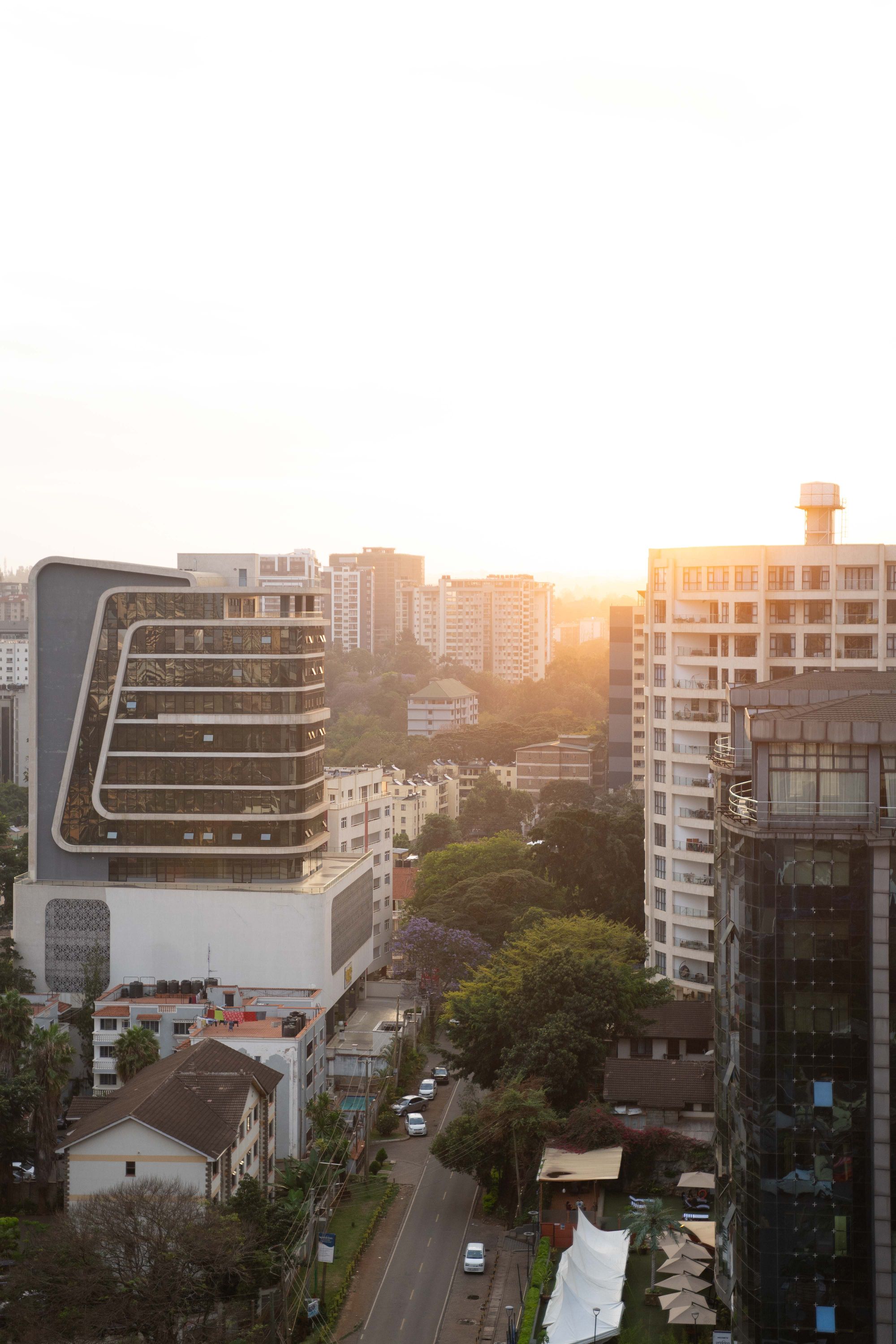
01The two decisions
Almost every booking mistake in central Nairobi comes from getting one of two things wrong, and neither of them is the hotel.
The first is whether your days are in the grid or out of it. If you are here for the museums, the market halls, the Archives and the rooftop, the centre is the one part of Nairobi where walking beats driving and you should be inside it. If your days are at the national park, in the suburbs or at an office campus, being inside the grid buys you nothing and costs you the two worst hours of traffic in each direction.
The second is what you intend to do in the evening. The CBD is a working district: it fills at seven in the morning and empties at seven at night. Nothing about that is dangerous in itself, but a visitor who books the centre expecting a walkable evening will be disappointed, and a visitor who books it expecting an early night with breakfast downstairs will be very well served.
02Four shortlists
First trip, no car: Kenyatta Avenue
The clearest orientation line in the city, the widest pavements, the older full-service hotels, and three minutes on foot to City Square. If you are going to be walking the grid every day, this is the default and it is usually right.
Grounds and quiet: Uhuru Park edge
The hotels facing the park have lawns on one side and the skyline on the other, and their guest scores are consistently the strongest in the centre on quiet and on grounds. Five minutes from the banks, and the only proper walk in the CBD starts at the door.
Working trip: Upper Hill
Not the CBD but the ridge above it: the newest towers in the country, meeting floors, and an expressway ramp that decides whether your airport run is short or endless. Nothing to walk to in the evening, which most work trips do not mind.
The city itself: Biashara Street
Thin on hotels and heavy on everything else. Serviced apartments on Koinange Street put you inside the market quarter, two minutes from City Market, the mosque and the library. The right call on a second visit.
03What this guide says to avoid
River Road and Muthurwa are the two areas where the advice is flat rather than nuanced. Both are genuinely worth walking in daylight, and neither is a place to sleep unless you have a specific reason such as a pre-dawn bus. The lodging stock there serves traders, the reviews reflect the noise, and the streets outside change sharply at night.
The Railway Quarter is a third case: not unsafe so much as empty. It is warehousing and railway land with almost no visitor stock, and the right move is to sleep on the avenue five minutes uphill and walk down for the museum in the morning.
Why there are no rates on this page
A nightly figure would be wrong within a week and this site would have no way to correct it at the speed the market moves. What does not go out of date is where an area sits, what is walkable from it, and what the street is like at eight in the evening. Live availability belongs with the booking partner.
04Three practical things
- Ask for a high floor or a courtyard room anywhere on Moi Avenue or Tom Mboya Street. Street noise is the single most common complaint in reviews of that quarter and it is entirely solvable at booking.
- Check whether the hotel has its own parking if you are driving. On-street parking in the grid is an active business rather than a convenience.
- If you have an early flight, weigh Upper Hill against the avenue purely on the expressway ramp. It is the difference between a manageable run and an open-ended one.
05Reading the three measures for a quarter
Every quarter page on this site carries the same three measures, and they are chosen because they answer three different questions a booking decision actually turns on. The first is the direct line from the junction of Kenyatta Avenue and Moi Avenue, given in kilometres and walking minutes. It is a straight-line figure computed from published coordinates at an easy pace, not a route. Treat it as a comparison between quarters rather than a promise: two places level on the direct line can sit ten minutes apart once you account for where the crossings and the footbridges fall.
The second is the band, and it is the measure that best predicts what a stay will feel like. The band describes the register of a quarter rather than its distance: the spine, the green edge, the western ridge, the market quarter, the eastern grid, the civic centre. A quarter can be close on the direct line and still be in a band that suits a different kind of trip. Kenyatta Avenue and the market quarter are a few hundred metres apart and belong to different evenings entirely, which is the whole reason the band is printed next to the distance rather than buried in the text.
The third is the after dark line, and it is the one to read first if the trip involves late arrivals or evenings out. It is not a safety score and it is not a substitute for current travel advisories, which this site tells you to read alongside the page rather than instead of it. It is a plain statement of what a quarter is like once the offices empty: the avenue goes quiet but stays lit, the parks close and enforce it, the ridge is safe and dull, and River Road is the one place where the answer is flat.
Use them in that order. The direct line tells you whether the quarter is even in the running. The band tells you whether its days and evenings match the trip you are actually taking. The after dark line tells you whether the last hour of the day works. None of the three tells you anything about the hotel itself, which is what the booking partner's guest scores are for, and none of them is a substitute for asking the specific operator about the specific block.
The direct line
Computed from published coordinates at an easy pace, straight line rather than a route. Use it to compare quarters, not to predict a door-to-door time.
The band
The register a quarter works in, from the spine to the eastern grid. The best single predictor of how a stay will feel day to day.
The after dark line
What the quarter is like once the offices empty. Read it first for late arrivals and evenings, and read it alongside current travel advisories.
06Matching the trip to the quarter
A first visit with no car points at Kenyatta Avenue and nowhere else. The pavements are the widest in the centre, the crossings are signalled, the orientation line is easy to hold, and the walk to the market quarter, the civic block and the park all start from the same junction. The hotels are the older full-service kind, built for business travellers, and the reviews say what that means: strong on service and position, dated on decor. What the avenue does not give is an evening, and a first-timer who books it expecting one will spend the nights in the hotel or in a car heading west.
A working week points at Upper Hill and Community. The ridge holds the conference floors, the hospital cluster and most of the office space the grid has been losing, so the meeting is more likely to be a short walk than a drive, and the expressway ramp puts the airport in a different category on a clear morning. The stock is the newest and best reviewed in central Nairobi, with gyms, pools and airport desks. The trade is real: there is nothing to walk to after the offices close, and the hotel bar is the evening.
A market trip points at the Biashara Street quarter, though the honest answer is that a market trip does not need a bed in the market quarter at all. The cloth shops, the tailors upstairs, the City Market hall and the mosque gate are all within a few minutes of the avenue, and the stock in the quarter itself is small and mostly above shops, with a handful of serviced apartments on Koinange Street. Sleep on the avenue and walk north in the morning; the fabric does not close at check-out.
An early flight is the one decision that genuinely overrides everything else, and it points at Upper Hill on the expressway ramp rather than at the grid. A long stay points at serviced apartments, and the best-reviewed of those sit on Koinange Street at the edge of the market quarter; the kitchen and the space matter more over a fortnight than the lobby does. In both cases the quarter is being chosen for one specific leg of the trip rather than for the trip as a whole, and that is a legitimate way to choose.
07When the centre is the wrong answer
This page is a guide to the CBD and it cannot pretend the CBD is the right base for every itinerary. If the days are at the national park, at an office campus, in the suburbs or at a hospital outside the grid, sleeping in the centre buys nothing and costs the two worst hours of traffic in each direction. The same applies to a trip built around the malls, the restaurants and the nightlife, which are west and south of the grid, and to a long stay where a kitchen and a washing machine matter more than an address. The centre is a working district, and a trip that has no business in it should sleep where the business is.
The second honest limit is that this guide prints no rates and no availability, and cannot therefore tell you whether any of it is affordable on a given date. Rates in the centre move with the conference calendar, the diplomatic calendar and the season, and the same room can read very differently in two different weeks. The three measures tell you where a quarter sits and what it is like after the offices close. What they cannot tell you is what any specific hotel is asking on the nights you want, and the page will not invent a figure to fill that gap.
The third limit is hours. Opening times for the galleries, the mosque, the library, the market halls and the rooftop deck are all set by the operators and they all move, sometimes at short notice and sometimes for state events. This page therefore prints no opening or closing hour for any of them, and says instead which desk to ask at. The one time rule it will state plainly is that the parks close at dusk and that the rule is enforced. Everything else is a matter for the operator on the day.
There is a fourth limit worth naming, which is the block itself. Street-level conditions in any large African city change by the street and by the hour, and guidance specific to the actual block you are booking is worth asking for from the hotel or the operator rather than taking from a page. That is precisely why the after dark line is printed beside every quarter rather than left to a general warning, and why the River Road entry gives a flat answer instead of a nuanced one. A guide that hedges everywhere is of no use when the answer is genuinely simple.
Where this page comes from
Desk research, not fieldwork. Nobody writing this stood on the corner with a stopwatch, and a page that implied otherwise would be the least trustworthy thing on the site. The specifics above came from here:
- Guest ratings and review counts: the booking partner’s published scores.
- Distances and walking minutes: computed from published coordinates, direct line at 4.8 km/h.
- Expressway ramp locations: Nairobi Expressway operator information.
- Distances and walking minutes: computed from published coordinates, direct line at 4.8 km/h.
- After-dark guidance: current travel advisories, read alongside this page rather than replaced by it.
Opening hours, ticketing and market days change. No hotel or operator pays to appear here.
08Questions
Is the CBD a good place to stay at all?+
For a trip built around the old centre, yes: it is the one walkable district in Nairobi and the landmarks are inside twenty minutes of each other. For a trip built around the park or the suburbs, the ridge or the western suburbs will serve you better.
Which single area would this site pick?+
Kenyatta Avenue for a first visit, and the Uhuru Park edge if grounds and quiet matter more than being in the middle of the grid.
Are serviced apartments a better idea than hotels?+
For stays over a few nights in the market quarter, often yes: more space, a kitchen, and the same walking radius. Guest scores on the Koinange Street apartments run strong on space and weaker on service, which is the usual trade.
Does this site earn from bookings?+
Yes, through the booking partner, and no hotel pays for placement or for a better write-up.
Which quarter is best for a trip that mixes meetings and a few days off?+
Upper Hill for the working days, because the conference floors and the hospital cluster are there and the expressway ramp shortens the airport run. The park edge works for the days off, and the walk down into the grid is short. Splitting a stay between the two is reasonable and often better than one compromise address.
Where should a first-time visitor sleep if the evenings matter as much as the days?+
Not in the grid at all, if the evenings are the point. The centre is a working district that fills early and empties early, and the restaurants, rooftops and nightlife are a ride west. Sleep on the ridge or further west and travel in for the daytime sights, or accept that the centre means an early night and breakfast downstairs.