01Why the mosque gets its own page
Jamia Mosque is the principal mosque of the city, built in 1925, and it is the oldest building in the centre that is still in daily use for the purpose it was built for. That alone would earn it a page. The city keeps very little of its early fabric in working order, and this building is not a preserved shell or a museum interior. It is a working place of worship that has held the same corner of Banda Street for a century while everything around it was rebuilt, extended, renamed or demolished.
The page exists because the mosque is easy to misread from the street. Three silver domes and twin minarets close the market block, and a traveller walking down from Kenyatta Avenue meets them as a piece of skyline, not as a destination. The building is the end of the view: cloth shops, the flower sellers, the market hall, then the mosque. Treating it as a photograph stop undersells it. Treating it as a public attraction oversells what any visitor is entitled to.
There is also a practical reason for a separate entry. The mosque is a religious institution with its own committee, its own prayer calendar and its own rules about who is received and when. Those arrangements are not a travel product. They cannot be booked here, timed here or priced here, and they should not be presented as though they were. A page that says so plainly is more useful than one that pretends to a schedule the committee has never published to visitors.
Read this page as a settling of terms. It describes what stands on Banda Street, how the building meets the street, and the etiquette the site publishes for anyone who wants to look from the gate. It does not promise entry, and it does not print a timetable. A building of this age and this importance deserves to be approached with the right expectations, and the right expectations start with respecting the fact that it belongs to its congregation first.
02The building, the street and the gate
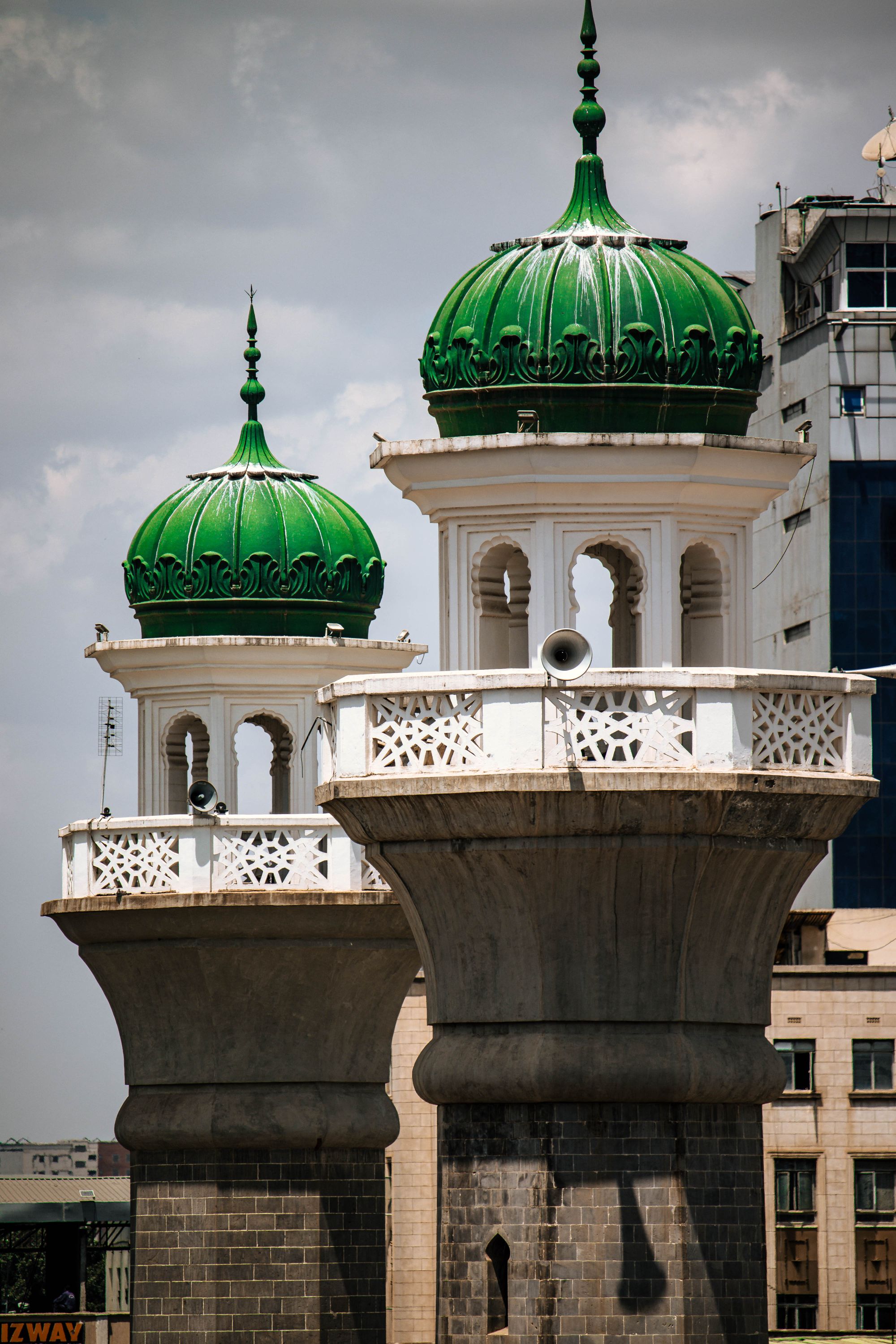
Three domes, two minarets, and a frontage that runs along Banda Street. The composition is unmistakable once you are on the street: the domes are silver and sit above the roofline of the surrounding block, and the minarets frame them. The building reads as the close of the market quarter rather than as a monument standing free. It shares its street with shops, the library at the other end, and the ordinary traffic of a working commercial district. The architecture is part of a continuous frontage, and that is the point.
Banda Street itself is the quietest good street in the centre. It runs between the mosque at one end and the McMillan Memorial Library with its marble lions at the other, and the pavement is shaded for most of its length. A walk along it takes minutes, not an hour, and the reward is a street where the buildings have not all been replaced. The mosque anchors one end of that walk. Anyone heading for the gate passes the market block first, which is why the two are naturally combined.
The row list above sets out the four things worth holding in mind: the three domes and two minarets, the Banda Street frontage, the gate and its etiquette, and what the building is not. That last part matters. Jamia Mosque is not a heritage site with a visitor centre, not a ticketed attraction, and not a stop on a guided circuit. It is a mosque. The gate is a real threshold with a real keeper, and the answer you get there is the answer.
Etiquette, as this site publishes it, is straightforward. Dress modestly before arriving: covered shoulders and legs, and a scarf for anyone who needs one. Ask at the gate about visiting outside prayer times rather than walking in. Take Friday prayers as the wrong time to ask for a look and return on another day. Photograph the domes from the street, and leave people at prayer and the interior itself out of the frame without clear permission.
Three domes, two minarets
The silhouette that closes the market block is a 1925 build, not a colonial-era office. The domes sit above the Banda Street facade and are visible from the junction before the building itself.
Banda Street frontage
The mosque holds one end of Banda Street, with the McMillan Memorial Library and its marble lions at the other. Narrow pavements, shaded for most of the day, and the quietest good walk in the grid.
The gate and the etiquette
Visitors are received outside prayer times, and modest dress is required. The site publishes that guidance and repeats it here: ask at the gate rather than assume, because the receiving arrangements are the mosque's to set.
What it is not
This is not a museum with a turnstile and a printed leaflet. It is a working mosque in the middle of a market quarter, and the terms of a look inside belong to the committee, not to this page.
03What this page will not tell you
The honest limitation here is that the mosque is not run for visitors, and the page cannot pretend otherwise. There is no published receiving time to print, no set day for non-Muslim guests, and no fixed arrangement that holds across the year. The prayer calendar moves through the seasons, so any window that existed last month may not exist this month. A travel site that invented a schedule would be doing the reader a disservice and the congregation a discourtesy at the same time.
What this page will not do is dress up guesswork as guidance. It prints no opening hour, no closing hour, no receiving time and no ticket figure, because none of those belong here, and because printing them would imply a certainty nobody has. The bullet list above gives the etiquette that can be stated without qualification. Everything beyond that, including whether a look inside is possible on the day of a given reader's visit, is settled at the gate by whoever keeps it.
These pages are compiled from published information and the site's own checks, not from a visit. Nobody writing this has stood on Banda Street or spoken to the committee, and no page here should be read as a first-hand account. Opening arrangements, receiving practice and anything else that moves week to week are not printed here for that reason. Where a detail is stable, such as the building's date and its place as the principal mosque of the city, it is stated. Where it moves, it is left alone.
The callout alongside says the same thing in fewer words: the gate decides. Ask there, in daylight, outside prayer times, and plan the rest of the quarter around whatever answer comes back. That is not a dodge. It is the only accurate instruction available, and it puts the decision where it belongs, with the people who set it. A reader who arrives expecting to negotiate rather than to collect a promised service will have a better time of it.
- Dress modestly before you arrive: covered shoulders and legs, and a scarf for anyone who needs one, because the requirement is set by the mosque and not by this page.
- Ask at the gate about visiting outside prayer times rather than walking in, and accept whatever answer is given.
- Treat Friday prayers as the wrong time to ask for a look, and come back on another day instead.
- Photograph the domes from the street; do not photograph people at prayer or inside the building without clear permission.
What this page cannot print
The mosque's visitor arrangements are the committee's to set, and they change with the prayer calendar. This page prints no opening hour, no receiving time and no ticket figure, because none of those belong to a travel site. The honest answer is that the gate decides. Ask there, in daylight, outside prayer times, and plan the rest of the quarter around whatever you are told.
04How to use the visit
Build the mosque into a walk rather than making it the whole errand. The quarter around it is a daytime district with narrow shaded pavements and the shortest distances in the centre, and the route works best on foot from Kenyatta Avenue, where the grid is easy to pick up. Come up through the market block, take in the cloth shops and the flower sellers, then let the domes close the view at the end of Banda Street. The building lands better that way.
Time the approach for daylight and for a day that is not Friday. Mid-morning through mid-afternoon is when the quarter is at work and the streets are at their most straightforward, and it is also when a gate enquiry is least likely to interrupt anything. If the answer at the gate is that today is not possible, that is not a failed visit. The domes and the frontage are on the street, and the street is free to walk. Take the exterior properly and leave the interior for another occasion.
Pair it with the rest of the block rather than treating it as a standalone stop. The City Market hall is a short walk away with its produce, fish counter and curio gallery, and the McMillan Memorial Library sits at the other end of the same street. A reader who wants architecture gets three buildings of different periods within a few minutes of each other. Check current opening notices for the market and the library before setting out, since those move too, and keep the mosque as the fixed point at the end.
The verdict is simple. Go for the exterior, the street and the setting, and treat anything more as a gift rather than a right. Dress for it before leaving the avenue, ask at the gate in daylight, accept the answer, and do not photograph people at prayer. If entry is offered, take it quietly and briefly. If it is not, the walk still holds: three silver domes, twin minarets, and the oldest working building in the centre, seen from the street that has always belonged to it.
Where this page comes from
Desk research, not fieldwork. Nobody writing this stood on the corner with a stopwatch, and a page that implied otherwise would be the least trustworthy thing on the site. The specifics above came from here:
- Jamia Mosque: Jamia Mosque Committee, visitor guidance.
- Jamia Mosque: the mosque’s published visitor guidance.
- City Market and McMillan Library: Nairobi City County heritage listings and the library trust’s restoration notices.
Opening hours, ticketing and market days change. No hotel or operator pays to appear here.
05Questions
Can I go inside Jamia Mosque?+
Visitors are received outside prayer times and modest dress is required. The receiving arrangements are set by the mosque committee and can shift with the prayer calendar, so the gate is the authority. Ask there, in daylight, rather than relying on anything printed.
Is there an entry fee?+
This site prints no price of any kind, and the mosque is not a ticketed attraction with a published tariff. If anything is asked for at the gate, it will be explained there. Treat the building as a place of worship rather than a paid exhibit.
How do I get to Banda Street?+
Banda Street runs off the market quarter, a short walk north of Kenyatta Avenue, with the McMillan Memorial Library at one end and the mosque at the other. Driving into these streets is a mistake: they are narrow and parking is street-side and full. Walk it.
Should I combine it with the market?+
Yes, and the order matters. The market halls and the cloth streets are a daytime trade, quietening by late afternoon, so walk the market first and finish at the mosque end of Banda Street. Nothing here is worth staying for after dark.