01What survives of the market quarter
Central Nairobi keeps more of its market past than the skyline suggests. The 1930s City Market hall still trades on Muindi Mbingu Street, the upper gallery of curio stalls still sits above the produce floor, and the Biashara Street frontages still stand one shop wide with tailors above them. Jamia Mosque closes the block north, and the McMillan Memorial Library holds its corner behind marble lions. This page is about the buildings that are still standing, the ones that are not, and what has gone up where the missing ones were.
The quarter earns a page because it is the one part of the CBD where the architecture and the trade are the same age. A market hall from the 1930s is still a market hall. A cloth street from the 1900s is still a cloth street. Most of the centre replaced that kind of continuity with office floors and banking halls long ago, which is why the survivors here are worth naming one by one rather than in a general phrase. The names matter more than the postcard.
It is also a short page because the list is short. The vanished market buildings did not leave much behind: a few deco facades, a handful of old sheds, and a run of street names that still describe trades the buildings no longer house. Anyone expecting a district of preserved market halls will not find one. Anyone expecting four buildings that genuinely carry the retail history of the centre will find them on the Google row and the bullet list, which are the factual part of this piece.
Treat this as an architectural walk with a purpose: to see what a working market quarter looks like when two or three of its buildings have been kept in use rather than kept as exhibits. The verdict is straightforward. Start with the City Market hall, walk the Biashara Street frontages, look up at Jamia Mosque, and finish at the library lions. The rest of the centre can wait.
02The halls and frontages still standing
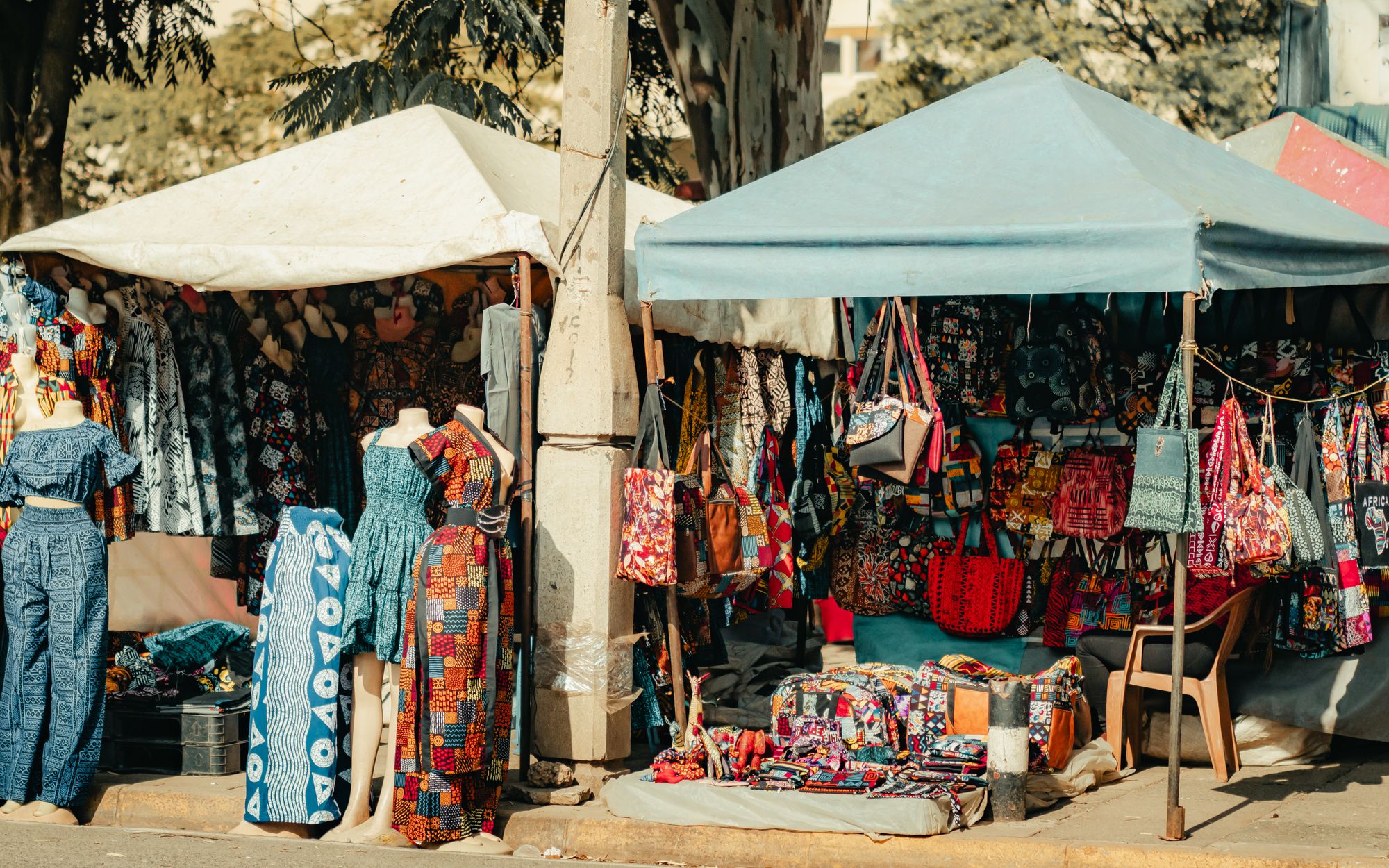
The City Market hall is the anchor. A 1930s produce hall on Muindi Mbingu Street, it keeps the produce trade at the centre, the fish counter at the back, and the gallery of curio stalls around the upper level. The deco frontages of Biashara Street are the second piece: narrow shopfronts, one family wide, cloth and haberdashery and school outfitters, with tailors working above. Together they form the spine of what is left of the old market quarter.
Jamia Mosque is the third survivor and the one that most changes the block. Built in 1925 on Banda Street, it closes the north end with three silver domes and twin minarets. Visitors are received outside prayer times, modest dress is required, and the arrangement is made at the gate rather than booked in advance. The McMillan Memorial Library is the fourth, a 1931 reading room with marble lions on Banda Street, restored in phases. It is the quietest of the four and the easiest to walk past without noticing.
What replaced the missing market buildings is less impressive and worth seeing anyway. Office floors, banking halls and subdivided retail arcades stand on most of the old market plots, with ground floors cut into smaller units and the original trade pushed upstairs or out of the quarter entirely. The effect is honest: the centre kept its market streets and lost its market sheds. A walk that looks for the lost buildings will mostly find their replacements, and that is part of the story rather than a disappointment.
The practical verdict is to give the quarter an hour and no more. The produce trade is a morning business and the hall empties well before the shops on Biashara Street do, so the two halves of the walk run on different clocks. The curio gallery is the one part where bargaining is expected, and the fabric shops are the one part where a purchase takes days rather than hours. Neither is a reason to skip either half.
City Market hall
A 1930s produce hall of deck-and-arch construction, still trading as a market. Produce and a fish counter occupy the nave, with a curio gallery around the upper level.
Biashara Street frontages
The oldest retail street in the centre still doing what it was built for. Shops one family wide, cloth and haberdashery by the metre, tailors working above the shopfronts.
Jamia Mosque
Built in 1925, the principal mosque of the city, closing the Banda Street block with three silver domes and twin minarets. Visitors are received outside prayer times; modest dress is required.
McMillan Memorial Library
A 1931 reading room behind marble lions on Banda Street, restored in phases. Opening arrangements are set by the trust and move, so check the current notice before setting out.
03What this page cannot tell you
The limit of this page is that it is compiled from published information and the site's own checks rather than from a visit. Nobody writing it has walked the quarter, timed the streets or tested the halls on a working morning. That means the architectural descriptions can be relied on as descriptions, and the arrangements around them cannot. Opening arrangements, ticketing and anything that moves week to week are not printed here, and a reader who needs them should go to the operator rather than to this page.
There is a second limit, which is that a market quarter is a working place and a page about its buildings is not a page about its trade. Stall layouts inside the City Market hall get reorganised, the produce floor fills and empties on its own rhythm, and the balance between curio stalls and produce stalls is not fixed. None of that is described here, because none of it holds still long enough to describe honestly in print. Take the building as fixed and the contents as variable.
What the page is confident about is the shape of the walk and the order of it. The halls and the streets around them are shaded for most of the day, the distances are short, and the quarter is a daytime one in the plainest sense. After the offices close, the shutters come down street by street and there is nothing open and nothing to stay for. The page will not pretend otherwise, and it will not pad the list to fill the space.
For the rest, ask at the desk. The City Market and the library publish their own notices, the mosque receives visitors outside prayer times by arrangement at the gate, and the fabric shops will tell you what a tailor can do and how long it takes. Confirm before walking down, and treat any hour quoted elsewhere as needing confirmation on the day. That is a better method than a printed timetable that was correct last season.
- Treat the quarter as a daytime one: the halls shut in the late afternoon and the shutters come down street by street after that.
- Expect the produce trade to be a morning business, with the market hall emptying well before the shops on Biashara Street do.
- Bargain in the curio gallery if you buy there: the opening figure and the closing figure are far apart, and that is expected.
- Ask the fabric shops to point you to a tailor upstairs or next door, and agree the timeline before any cloth is cut.
On hours and figures
This page prints no opening hour, no closing hour and no ticket price, because those are set by the operators and move. The City Market and the library publish their own notices, and the mosque receives visitors outside prayer times by arrangement at the gate. Check before you walk down, and treat any hour quoted elsewhere as needing confirmation on the day.
04What to do with this page
Use this page to plan an architectural hour, not a shopping day. Read the Google row first, then walk the four buildings in the order given: the City Market hall, the Biashara Street frontages, Jamia Mosque, the library. That order runs from the loudest building to the quietest and ends somewhere calm. If only one building gets an hour, the City Market hall earns it, because the produce floor and the upper gallery are the only place in the centre where the 1930s market brief is still visibly being carried out.
The bullet list is the working part of the page. Treat the quarter as a daytime one, expect the produce trade to be a morning business, bargain in the curio gallery, and ask the fabric shops about a tailor before any cloth is cut. Those four instructions cover almost everything that can go wrong on a short visit. They also explain why an afternoon arrival will find half the quarter already closed, which is the most common mistake and the easiest to avoid.
Pair the walk with the streets around it rather than treating it as a single stop. Muindi Mbingu Street carries the flower sellers and the produce entrance. Banda Street runs between the mosque and the library and is the quietest good street in the centre. Koinange Street marks the western edge of the quarter and the transition back to offices. Ten minutes in any direction puts a reader into a different kind of street, which is what makes the market quarter worth crossing the grid for.
Finally, do not buy from this page. No trader, tailor or operator pays to appear here, and the site names buildings rather than businesses on purpose. The value of the page is the shortlist and the caveat: four survivors, one lost set of market sheds, and an honest note that the arrangements around them move. Go for the architecture, buy what you actually need, and ask at the counter for everything this page has deliberately left out.
Where this page comes from
Desk research, not fieldwork. Nobody writing this stood on the corner with a stopwatch, and a page that implied otherwise would be the least trustworthy thing on the site. The specifics above came from here:
- City Market and McMillan Library: Nairobi City County heritage listings and the library trust’s restoration notices.
- City Market: Nairobi City County market information.
- Street naming and the colonial grid: Nairobi City County and National Archives published histories.
Opening hours, ticketing and market days change. No hotel or operator pays to appear here.
05Questions
Which of the old market buildings are still standing?+
The City Market hall of the 1930s is the principal survivor, still trading as a produce market with a curio gallery above. Alongside it, the Biashara Street shopfronts still carry the retail trade they were built for, and Jamia Mosque and the McMillan Memorial Library both stand on Banda Street.
What replaced the market buildings that did not survive?+
The halls that went were replaced by offices and shops rather than by markets, and the retail trade moved into subdivided ground floors and arcades. This page describes what is standing rather than listing what has gone, since the losses are documented unevenly.
Can I walk the whole quarter in an hour?+
Yes, the market quarter is compact and its streets are short, so the halls and frontages can be seen in about an hour on foot. Driving into it is a mistake: the streets are narrow and parking is street-side and full. Allow longer if you intend to buy cloth or have anything made up.
Why does this page not give opening hours or entry prices?+
Those are set by the operators and they move, so printing one would be stale within a season. The market and the library publish their own current notices, and the mosque arranges visits at the gate. Ask on the day rather than relying on a figure repeated here.