01Why the civic block is worth a page
The block around City Square and the KICC is Nairobi's one planned set piece, the part of the centre that was composed rather than allowed to accumulate. Parliament, the Supreme Court, City Hall, the Holy Family Basilica and the mausoleum of the first president are arranged around open paving closed to through traffic, and the Kenyatta International Convention Centre rises out of the middle of them. It is the most legible quarter in the city. Nowhere else in the centre can you stand still, take in the whole arrangement at once and understand how the state chose to present itself. That alone justifies a page.
What makes the block worth more than a photograph is the decade it belongs to. The civic buildings are not a collection of separate landmarks but a single argument in concrete about what an independent Kenya wanted to look like. The basilica was completed in the 1960s, the convention centre in 1973, the mausoleum in 1978. Read them together and you are reading a period, not a tower. The conference centre with its amphitheatre roof, the cathedral that holds thousands, the parliament, the tomb: each was placed to be seen from the same paving, and the paving was laid so that the viewer would move between them in a deliberate order.
This page treats the block as architecture and as a walk, in that order. It is not a guide to the whole central business district and it is not a list of things to do. It is an account of one civic composition, what each building contributes to it and what a visitor can reasonably expect to see. The practical notes are short because the block is small. The caveats are longer because the block is institutional and its institutions keep their own arrangements. The verdict is straightforward: if you see one part of Nairobi's centre, see this one, and see it in daylight.
The block also repays a second look. Most visitors come for the rooftop deck and leave without looking at anything else. That is a mistake. The basilica is a pale hall that can hold thousands and is usually quiet on a weekday afternoon. The mausoleum is guarded and viewed from outside the railing. The old Law Courts and City Hall give the square its civic frontages and its scale. None of these is a secret, and none of them is hidden, but the deck has a way of absorbing all the attention. Give the rest of the paving the time you gave the lift.
02The buildings, one at a time
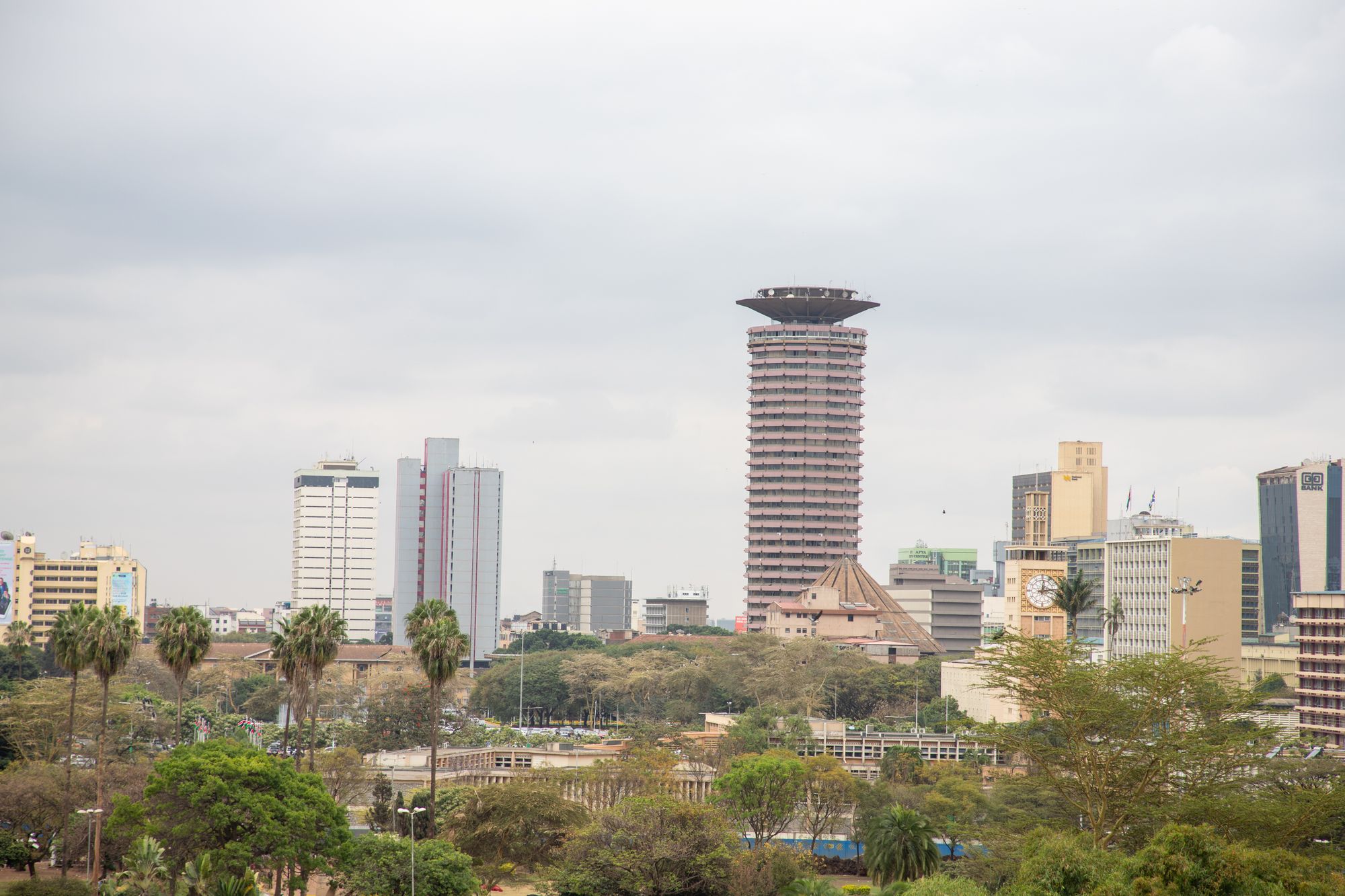
The Kenyatta International Convention Centre is the reason most people come, and the reason the block reads as a set piece. A cylinder in exposed concrete, finished in 1973 to a design by Karl Henrik Nostvik with David Mutiso, it rises above the paving with a conference amphitheatre at its foot and a helipad deck on the roof. The deck is the point: a ticket at the ground-floor desk, a lift most of the way, a short stair, and the best view of the city there is. Bring identification. The light in the morning is better for the view north and west, and the deck closes in bad weather, so the morning is also the safer bet.
The Holy Family Basilica faces the square as the counterweight to the tower: a pale concrete hall completed in the 1960s that seats several thousand people. It is the one building on the block that is primarily a room rather than a monument, and it works as a room. Between services it is open, and on a weekday afternoon it is usually empty. Step in for the scale and the quiet. The contrast with the noise and glare outside is the whole experience of the interior, and it costs nothing but the time you spend standing there.
Parliament and the courts occupy the institutional side. Parliament Buildings carries the clock tower that serves as the quarter's landmark, and public access runs through Parliament's own visitor programme, which is arranged in advance rather than walked into. The Supreme Court sits in the old Law Courts building, and City Hall faces the square from another side. The architecture here is more conventional than the tower and the basilica, but it supplies the frame. Without the civic frontages the paving would be a plaza with nothing to look at. Security around Parliament and the ministries is real, and the pavements along Harambee Avenue are watched.
The Kenyatta mausoleum stands on the Parliament side of the square, built in 1978, guarded, and viewed from outside the railing. It is the smallest element in the composition and the one that fixes the block to the decade most tightly: the conference centre, the cathedral, the parliament and the tomb all belong to the same short span of years. Treat the four as one building programme. The tower gives the skyline its shorthand, the basilica gives the square its volume, the Parliament gives it the clock, and the mausoleum gives it a date. Walk them in that order and the block makes sense.
Kenyatta International Convention Centre
A 28-storey cylinder in exposed concrete finished in 1973, with a conference amphitheatre at its foot and a rooftop deck the public can stand on. The deck is ticketed at the desk and can close for state events or weather.
Holy Family Basilica
The cathedral facing the square, completed in the 1960s, a pale hall seating several thousand. It is open between services and tends to be empty on a weekday afternoon.
Parliament and the courts
Parliament's clock tower is the landmark, with public access by arrangement through its own visitor programme. The Supreme Court sits in the old Law Courts on the square's western side.
The Kenyatta mausoleum
Built in 1978 on the Parliament side of the square, guarded, and viewed from outside the railing rather than entered. It is one stop on a walk, not a destination.
03What this page cannot know
The honest half is that the block is institutional, and institutions are not arranged for visitors. The KICC deck can close for state events or bad weather with little notice. The basilica opens between services, which means its useful hours are determined by a schedule this page does not have. Parliament's visitor programme runs to its own calendar. The paving is closed to through traffic but not to ceremony, and a state function can take the square out of use for a morning. None of this is a warning against going. It is a warning against planning a day around a single opening that may not be an opening when you arrive.
For that reason this page prints no opening hour for the deck, the basilica or the visitor programme, and it will not guess at one. Opening times are set by the operator and they move. A figure copied here would be wrong by the time it was read, and a page that prints a wrong hour is worse than a page that prints none. Check at the ground-floor desk at the KICC, or with the basilica's own notice, or through Parliament's visitor programme, on the day you intend to go. The desk is the authority. This page is not.
The same applies to anything that moves week to week: which parts of the square are fenced for works, whether the deck is open, whether photography is being discouraged near the ministries, and whether a conference has filled the hotels around the block. This page is compiled from published information and the site's own checks, not from a visit. Nobody writing it has stood on the paving or taken the lift to the deck. That is a limitation and it is stated plainly rather than disguised. What can be given reliably is the architecture, the arrangement and the shape of the walk. What cannot be given reliably is the state of any door on any given morning.
So the useful stance is to treat the block as a daylight walk and to confirm the two things that actually vary before setting out: whether the deck is open and whether the square is clear. Both are answered at the site or by the operator, and neither is answered here. Ask before photographing around Parliament and along Harambee Avenue, where security is real and the pavements are watched. The institutions close with the working day and the paving is empty after dark, which suits a car for the return rather than a walk back through a lit and deserted square.
- Treat the square as a daylight walk: the institutions close with the working day and the paving is empty after dark, which suits a car for the return.
- Bring identification for the KICC deck, and go in the morning, which gives the better light for the view north and west.
- Ask before photographing around Parliament and the ministries along Harambee Avenue; the security is real and the pavements are watched.
- Check the deck's opening and any state closures at the desk or on the operator's own notice, because this page prints no hour for it.
Why no hours are printed here
The deck, the basilica and Parliament's visitor programme each keep their own hours, and the rooftop can close for state events or bad weather without much notice. Opening times are set by the operator and move. No figure is printed because none of them is fixed enough to be useful by the time you read it. Check at the desk, or with the operator, on the day.
04What to do with the decade
Give the block half a day, not an hour. Start on the paving in the morning, when the light is behind you for the view north and west and the institutions are open in the way institutions are open. Walk the square once without going into anything, so the arrangement registers: Parliament and the courts on one side, City Hall on another, the basilica facing across, and the tower in the middle of it all. Then take the buildings one at a time. The order matters less than the slowness. This is a quarter that rewards standing still.
Do the deck first if the weather is clear, because that is the one element that can be taken away from you by a state event or a cloud, and do it with identification in a pocket. Then the basilica, which asks nothing but quiet. Then the outside of Parliament and the mausoleum from the railing. If Parliament's visitor programme has a slot and you have arranged it in advance, take it; if not, the clock tower is still worth the walk past. Finish the morning on the paving with the whole composition in your head, which is the only way the block is ever understood as one thing rather than four.
Leave the afternoon for the edges. Three minutes on foot from Kenyatta Avenue is the sensible approach, and the avenue itself is the cleanest line back into the rest of the centre. The conference hotels around the block feed delegates rather than walkers, so lunch is a short walk north to the office trade off the avenue rather than a search around the square. If the deck was closed, the day is not lost: the basilica, the civic frontages and the mausoleum are the substance of the block, and the view is the bonus, not the reason.
What you should carry away is the decade, not the tower alone. The convention centre, the cathedral, the Parliament and the tomb were built within a few years of one another and placed deliberately around the same open paving, and that decision is the most interesting thing in the centre of Nairobi. A visitor who notices only the cylinder has seen the shorthand and missed the argument. Walk the four, in daylight, with the arrangements confirmed at the desk, and the block will read the way it was drawn.
Where this page comes from
Desk research, not fieldwork. Nobody writing this stood on the corner with a stopwatch, and a page that implied otherwise would be the least trustworthy thing on the site. The specifics above came from here:
- Building history and public access: Kenyatta International Convention Centre visitor information.
- Distances: computed from published coordinates, direct line from Kenyatta Avenue at Moi Avenue.
- Architectural attribution: published architectural records for the 1973 building.
Opening hours, ticketing and market days change. No hotel or operator pays to appear here.
05Questions
Is the KICC rooftop deck open to the public?+
Yes. A ticket is bought at the ground-floor desk, a lift goes most of the way, and a short stair leads to the helipad. Bring identification and expect closures for state events or bad weather. The operator sets the hours, so check before you commit to the lift.
How do you reach the square from Kenyatta Avenue?+
On foot, and it is short. The direct line from Kenyatta Avenue at Moi Avenue is 0.53 km, around 7 min, and Wabera Street is the simplest approach past the Nairobi Gallery. Vehicles are kept off the square itself, which makes the paving the easy walking in the centre.
Can you photograph the buildings?+
On the rooftop deck, photography is expected and the view is the point. Around Parliament, the Supreme Court and the ministries on Harambee Avenue it is not: ask first, or keep the camera down. Government security in this block is genuine and visible.
Is the square worth visiting in the evening?+
No. The institutions close with the working day and the square is empty after dark, lit but with nothing open. Daylight is when the deck, the basilica and the walk between the civic buildings all work. For the evening, take a car elsewhere.