01What the Maasai Market rota actually is
The Maasai Market is not a building and it is not a street. It is a group of traders who set up on open ground, and the day of the week decides which open ground they take. Within the centre, that pitch falls inside the City Square and KICC quarter, which is the civic block of paving, flags and government frontages on the western side of the grid. On a market day the stalls are simply laid out on the ground there, then taken down again when the traders pack up, leaving nothing behind to mark that anything happened.
That is why the market appears on this list and why it sits awkwardly on a map. It is a shopping stop, a craft stop and a bargaining stop rolled into one, and it exists in the centre only on the days the rota assigns to the centre. The stock is the same wherever it lands: beadwork, soapstone, kikoi cloth, carvings and jewellery, brought in by the sellers and spread out for handling. Nothing is fixed to the site, so the thing you are travelling to is the collection of traders rather than the place.
Treat the rota, not the address, as the fact you are checking. If you turn up on a day the market is pitched elsewhere, there is no market to find in the quarter, and no sign explaining where it went. The sensible approach is to decide the day first and the route second. The rest of this page deals with what is actually laid out, how to reach the pitch from the grid, what to settle before setting out, and who this is genuinely worth rearranging a day for.
02What is laid out on the ground
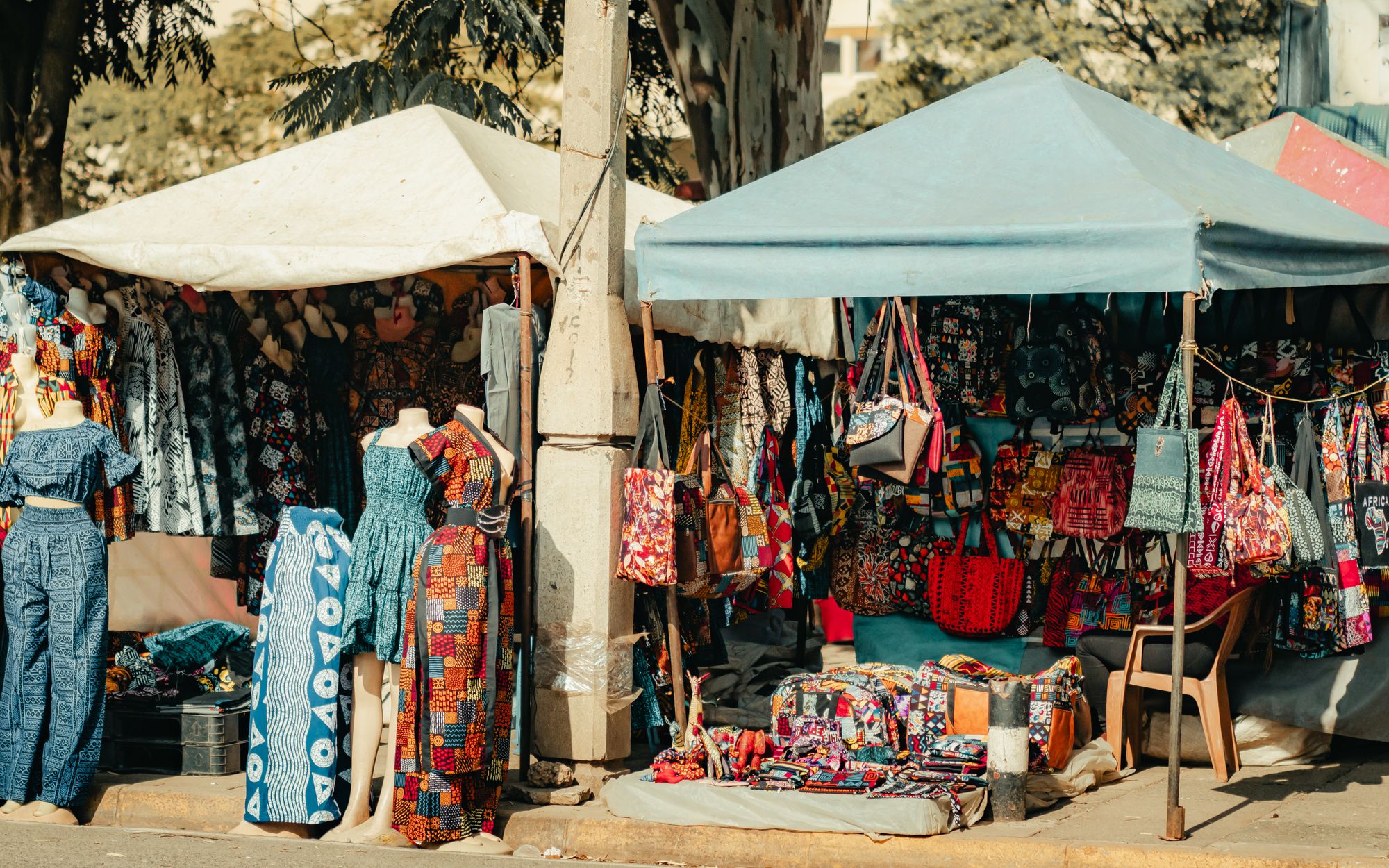
What you walk through is a line of ground sheets and low tables, not shopfronts. Sellers stand or sit behind the goods, and the whole thing reads as one long counter you move along at your own pace. Because it is assembled fresh each time, the exact stalls, the spacing and the number of sellers vary from one market day to the next. Expect gaps, expect a stallholder to call out as you pass, and expect any individual item to be the only one of its kind on the ground that day, since most pieces are worked by hand rather than batch made.
Four kinds of goods carry most of the market, and they are worth knowing before you start looking. Beadwork and jewellery is the densest category, from strung necklaces and bracelets to beaded belts and small leatherwork, and it is where most of the colour sits. Soapstone and carvings run from small animals and bowls to larger figures and boards, all of it heavy and most of it breakable, which matters if you still have a journey ahead. Kikoi and textiles are the practical buy: woven cloth, wraps and bags in strong stripes and checks.
Then there is bargaining, which is not a stall but the way the whole market works. Prices are opened high and settled by conversation, and the seller expects the conversation. Ask what a piece is made of, where it comes from and whether the price moves, and you will get a straighter answer than if you simply name a number. Walk the length once before buying anything, so you know what the ground is carrying, and keep in mind that a price agreed in a crowd is agreed in front of other sellers.
Beadwork and jewellery
Beaded necklaces, bracelets and earrings in bright colourways, laid on cloth or hung from frames. Quality varies stall to stall, so handle several before deciding, and ask what the beads are made of.
Soapstone and carvings
Soapstone bowls, animals and small figures, plus wood carvings in different sizes. The heavier pieces are the ones to think about carrying, since you walk away with whatever you buy.
Kikoi and textiles
Kikoi cloth, bags and printed fabric by the piece or the length. Colours fade in strong sun, so check the folds rather than the top of the pile. Ask whether the dye is colourfast.
Bargaining
Prices at a craft market are opening offers, not fixed. Decide what a piece is worth to you, offer it once, and be ready to walk on. Agree the figure before any wrapping starts.
03Getting to the pitch from the grid
The quarter is close to the middle of the grid, and the approach on foot from Kenyatta Avenue at Moi Avenue is the one that makes sense. That is roughly half a kilometre, a short walk of around seven minutes at an ordinary pace, and it is flat and paved for the whole of it. Vehicles are kept off the square itself, so the last stretch is on foot regardless of how you arrive. Walking in also lets you read the day: if there is no market on the paving, you will see that before you have committed any time to it.
Come in from Kenyatta Avenue rather than trying to be dropped at the stalls. The civic block keeps traffic out, and a driver asked to reach the market itself will either stop short on one of the surrounding roads or circle. If you are coming by matatu or taxi, agree the fare before you get on and name a junction on the avenue or a gate on the square rather than the market, which has no address to give. Once inside the block the walking surface is the best in the centre: open paving, low traffic, no hawker pressure on the paving itself.
The feel of the walk changes with the day. On a weekday the quarter is institutional traffic, officials crossing between the ministries and the courts, and the market, when it is there, sits as an island of noise inside that. At the weekend the offices empty and the square belongs far more to the stalls and the visitors. In daylight the block is legible and easy to cross on foot; after the offices close it empties quickly and there is no reason to linger. Plan the visit around daylight and around the rota, and the approach takes care of itself.
04Before you go, and one honest caveat
Most of what goes wrong at a market like this is settled in advance, and none of it is complicated. The rota is the first thing to confirm, because the day of the week decides which pitch the market takes and the pitch does move between sites. Carry small notes and coins, since change runs short at the stalls and a large note can stall a sale outright. Agree the price out loud and in full before anything is wrapped, count the item back before money changes hands, and keep bags zipped and phones out of hand when the ground is crowded, because the busiest days draw pickpockets alongside shoppers.
Ask before you photograph a stallholder or their goods, and understand that a long friendly conversation often ends with a seller asking for a sale, which is fair enough: the talk is the shop. If you do not want to buy, say so early rather than at the end. Beyond that, dress for standing about in the open, carry water, and think about what you can physically get home before you fall for something carved from stone. A purchase made in the middle of the day is still yours to carry for the rest of it.
One honest caveat belongs here. This page is compiled from published information and the site's own checks rather than from a visit, and anything that moves week to week is deliberately not printed on it. The rota, the opening and closing of the market, the days it operates and the sites it uses are all set by the traders and the county, and they shift between seasons. Check the current rota through the county's market information or with the venue itself on the morning you plan to go, and treat any older listing, including this one, with suspicion.
Check the current rota before you set out, because the day of the week decides which pitch the market takes and it does move. Carry small notes and coins, since change is often short at the stalls and a seller may not be able to break a large note. Agree the price out loud and in full before anything is wrapped, and count the item back before you hand over money. Keep bags zipped and phones out of hand in the crowd, as the market draws pickpockets alongside shoppers on its busiest days. Ask before photographing a stallholder or their goods, and expect a stallholder to ask for a sale after a long conversation.
- Confirm the current rota before you set out, because the day of the week decides which pitch the market takes and it does move.
- Carry small notes and coins, since change is often short at the stalls and a seller may not be able to break a large note.
- Agree the price out loud and in full before anything is wrapped, and count the item back before you hand over money.
- Keep bags zipped and phones out of hand in the crowd, as the market draws pickpockets alongside shoppers on its busiest days.
- Ask before photographing a stallholder or their goods, and expect a stallholder to ask for a sale after a long conversation.
Why no day is printed here
The rota is set by the traders and the county, and it changes between seasons and sites, so any day printed on a page ages badly within weeks. The same applies to opening and closing times: the market runs on daylight and on how many sellers turn up, which nobody publishes in advance. Check the current rota through the county's market information or the venue itself on the morning you plan to go, and treat any older listing with suspicion.
05Who it suits, and the verdict
This suits the traveller who wants to handle the goods before buying them and who is willing to talk a price down. It suits anyone buying gifts in quantity, since the ground carries enough variety to fill a bag in one pass, and it suits the visitor who wants an hour or two of something unpolished and open air between the civic landmarks. It does not suit anyone who needs a fixed address, a guaranteed opening, a card machine, a receipt or a quick in and out. It does not suit a tight schedule, because the rota can move the whole thing out from under a plan.
The verdict is straightforward. Go if you are in the centre anyway on a market day, and go in daylight with small money and an hour to spare. Do not build a trip around it until the rota is confirmed for the day you intend, and do not expect a curated craft hall: this is stock on ground sheets, sold by people who do this for a living and who are good at it. The bargaining is part of the visit rather than an obstacle to it, and the best buys are usually the ones that came out of a proper conversation.
The market earns its place on this list because it is the one thing in the civic quarter that is neither institutional nor permanent. Everything around it, the courts, the ministries and the tower, was placed deliberately and stays put. The market arrives, spreads out, and disappears again the same day. That is the reason to check before you go, and also the reason it is worth the walk when the day lines up.
Where this page comes from
Desk research, not fieldwork. Nobody writing this stood on the corner with a stopwatch, and a page that implied otherwise would be the least trustworthy thing on the site. The specifics above came from here:
- City Market: Nairobi City County market information.
- Market trading hours: Nairobi City County market information.
- Distances: computed from published coordinates, direct line from Kenyatta Avenue at Moi Avenue.
Opening hours, ticketing and market days change. No hotel or operator pays to appear here.
06Questions
Can I change money at the market?+
No. Stallholders deal in cash and expect the local currency, and there is no bureau de change at the pitch. Change money at a bank or an exchange in the centre before you go, and carry small notes so sellers can give change.
Is the market in the same place every day?+
No. The market moves around the centre and the malls by day of the week, and the rota is set by the traders and the county rather than fixed in advance. Confirm the current pitch on the morning you plan to go, because an old listing may send you to an empty yard.
Do I need to bargain?+
Yes, at a craft market the first figure is an opening offer rather than a fixed price. Decide what the piece is worth to you, make one clear offer, and be ready to walk away. Agree the figure before wrapping starts.
Is it safe to carry a camera or a large amount of cash?+
The market is a crowded public place, so keep cash modest, bags zipped and phones out of hand. Photography is not welcome at every stall, so ask before pointing a lens. Read your own government's current travel advice alongside this page rather than instead of it.
How do I reach the market from Kenyatta Avenue?+
The pitch sits in the City Square and KICC quarter, about 0.53 km from Kenyatta Avenue at Moi Avenue, roughly a 7 min walk depending on the day's location. Walking is the sensible approach, since vehicles are kept off the square itself. Ask at your hotel desk for the day's pitch before setting off.