01What the National Archives actually is
The Kenya National Archives is the national record office, not a museum with a single theme and not a display built for visitors. It occupies the old Bank of India building at the Hilton corner of Moi Avenue, which is why the front reads as a banking hall rather than an archive. The state papers, land records and official files that make it an archive at all sit behind the public rooms, and access to those is a separate matter for researchers. What a visitor walks into is the public face of that institution: galleries and a collection, housed in a building that was never designed to show them.
That is exactly why it earns a place on a page about the central grid. Almost every building on Moi Avenue and Tom Mboya Street is shops at street level with offices stacked above, and the pavement gives you no clue what any of it contains. This one gives you a way in. You step off the loudest pedestrian street in the country and into a cool hall with columns, then up into rooms with African art, textiles, beadwork and photographs. The contrast between the noise outside and the rooms inside is the thing worth knowing before you decide to climb the steps.
Treat it as a building to go into rather than a facade to photograph from the street. The site lists it as Ticketed and suggests allowing about one hour, which is honest for the public galleries. That hour is not a full survey of the institution, and it is not meant to be. It is enough to see the banking-hall interior, work through the collection rooms at an ordinary pace, and come back out onto Moi Avenue with a clearer picture of what the CBD hides behind its shopfronts. Longer if you read labels properly.
02What to see inside the banking hall
The interior divides into a few distinct things, and knowing which is which stops you from wandering. The Murumbi collection is the main draw and the reason the site calls this the most surprising room in the centre. The banking-hall columns are architectural: the structure of the old Bank of India, left in place, which is what gives the ground floor its scale. The photography rules are a constraint rather than an exhibit, but they govern what you can do here. The street outside is the fourth part, and it is not a lesser one.
The Murumbi collection is a collection of objects and images rather than a chronological narrative, and it rewards slow looking over coverage. African art, textiles, beadwork and photographs are the categories the site names, and the arrangement is dense: the phrase for it is stacked floor to ceiling, and that is the right expectation to carry in. If you go in expecting a sleek national gallery with a route through it, the density will read as clutter. If you go in expecting a working collection in an old banking hall, it reads as the point.
The columns are worth a minute of your attention on their own, because they explain the building. Banks of this period built halls to impress depositors, and the columns carry that intention even now that the counters have gone. The photography rules are posted and enforced, so check them before you unpack anything, and do not assume a phone is exempt because it is not a camera. The street outside is the busiest part of the visit in the literal sense: the pavement at this corner runs full through the working day, and stepping back into it is a jolt after the quiet.
The Murumbi collection
African art, textiles, beadwork and photographs, stacked floor to ceiling above the old banking hall. It is the reason the building is on a short list, and it is the most surprising room in the centre.
The banking-hall columns
The façade and the rooms behind it survive from the old Bank of India. The interior keeps its scale, so the collection reads as a room rather than a museum wing.
The photography rules
Rules on cameras and phones are posted at the desk and enforced. Read them before taking anything out of a bag, rather than after.
The street outside
Moi Avenue at the Hilton corner is the heaviest pavement in the centre. The entrance sits in the middle of it, so arriving and leaving are part of the visit.
03Reaching it from the grid on foot
The building sits on Moi Avenue at the Hilton corner, inside the eastern half of the grid and close to everything that matters in the centre. From Kenyatta Avenue at Moi Avenue, the distance is 0.27 km and the walk is 4 min. That is the honest figure and it is short enough that you should not be considering a vehicle. Anywhere else in the CBD, you are looking at a walk of a few minutes to a quarter of an hour, all of it on pavements that are carrying the heaviest pedestrian traffic in the country.
Do not take a car for the last stretch. Moi Avenue and Tom Mboya Street run parallel and between them move more people on foot than any other pair of streets in Kenya, and for most of the day a vehicle on either is slower than a walker beside it. Matatu stages sit at both ends and the crossings at Kimathi Lane and Muindi Mbingu are quicker on foot than any ride. If you are arriving from further out, get dropped at the edge of the quarter and cover the last part on foot rather than sitting in traffic on the avenue itself.
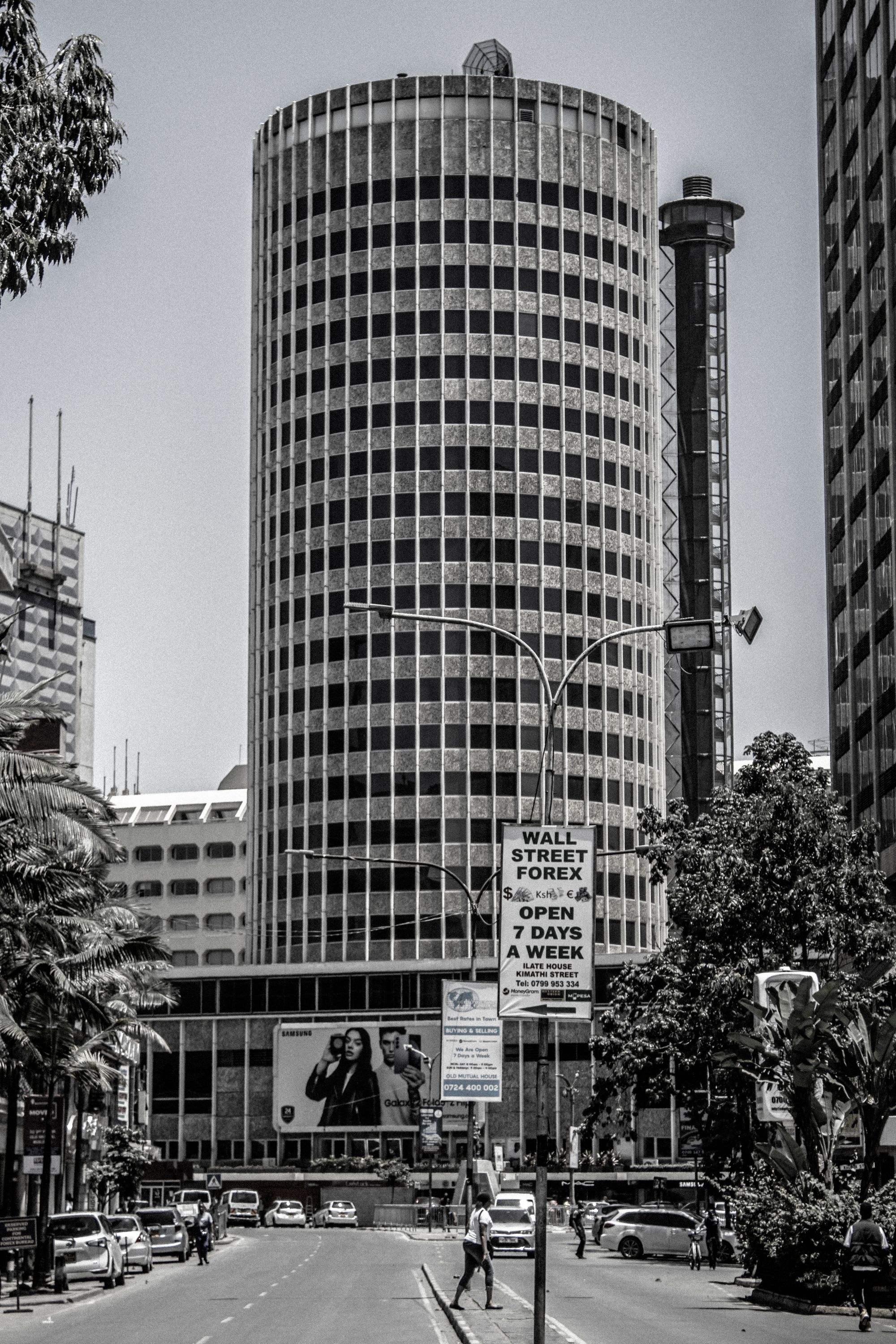
Use the Hilton roundabout as your orientation point. The circular tower is visible from most of these streets and marks the northern end of the Archives block, so if you can see the tower you are close. Coming from the railway end of Moi Avenue, the Archives is mid-way up on the left, at the corner where the avenue meets the hotel. The pavement on the southern half of the avenue carries the heaviest hawker pressure, so if the crowd is stopping you, cross to the other side and walk up on the quieter pavement. The building's own steps are the landmark you are aiming for.
04Before you go, and one honest caveat
Sort the practical side out before you set off, because this is a working institution in a commercial quarter and not a leisure attraction with a booking desk waiting for you. The arrangements that matter, opening and ticket collection and photography, are all handled on site. This page is compiled from published information and the site's own checks rather than from a visit, so opening arrangements and anything that moves week to week are not printed here. Check the current position with the Kenya National Archives before you travel, and again at the desk on the day.
Go in daylight, and keep one pocket for money with nothing carried in a hand. That is standard advice for the busy grid rather than a warning about this building: the pavements on Moi Avenue and Tom Mboya Street are crowded at every hour the shops are open, and a loose bag in a crowd is the part you control. Check the photography rules at the desk before unpacking a camera or a phone, since the rules are posted there and are enforced, and no online arrangement should be assumed. Buy or collect the ticket at the desk rather than turning up expecting otherwise.
Allow an hour inside, and treat the pavement outside as the busiest part of the day rather than the building. The hour covers the public galleries at an ordinary pace; if you read every label it will run longer. Confirm the current opening arrangements with the Archives directly, because the operator sets them and they move, and the callout on this page explains what is deliberately not printed here. The quarter itself thins out fast after the evening commute and is better avoided late, so take a car after dark rather than walking back through the grid.
- Go in daylight and keep one pocket for money, with nothing carried in a hand.
- Check the photography rules at the desk before unpacking a camera or a phone.
- Confirm the current opening arrangements with the Archives directly, since the operator sets them and they move.
- Buy or collect the ticket at the desk rather than assuming an online arrangement.
- Allow an hour inside, and treat the pavement outside as the busiest part of the day.
What this page does not print
Opening hours are set by the operator and change without notice, so no hour appears here. Ticket arrangements are made at the desk, and the cost belongs to the Archives, not to this page. Check the current position with the Kenya National Archives before setting out, and again at the desk on the day. Photography rules are posted there and are enforced.
05Who it suits and the verdict
This suits you if you want one interior in the CBD that is not a shop or a lobby, and you are willing to give it an hour. It suits anyone interested in African art, textiles, beadwork and photographs, and it suits the traveller who would rather see how a city institution actually works than look at a facade from the pavement. It also suits a hot middle of the day, when the streets are at their fullest and a cool hall with columns is a sensible place to be. Go in the morning if you want the pavement outside at its least punishing.
It does not suit you if you want a polished museum with a café, a shop and an audio route, because this is a collection in a former banking hall and it is dense rather than curated for a quick circuit. It does not suit anyone hoping to photograph freely, since the rules are posted and enforced. And it does not suit a tight schedule: the trip is a short walk and an hour inside, which is a poor use of a half day if you are trying to cover the whole centre. Pair it with the market quarter or the avenue churches and it earns its place.
The verdict is straightforward. This site would send a first visit to the banking hall, because it is the clearest single answer to the question of what the busy grid is hiding, and it sits 0.27 km and 4 min from Kenyatta Avenue at Moi Avenue, which costs you almost nothing to reach. Go in daylight, carry nothing loose, read the rules at the desk, and give it the hour. On a page about Moi Avenue and Tom Mboya Street, this is the one entry that takes you inside rather than past.
Where this page comes from
Desk research, not fieldwork. Nobody writing this stood on the corner with a stopwatch, and a page that implied otherwise would be the least trustworthy thing on the site. The specifics above came from here:
- Kenya National Archives and the Murumbi collection: Kenya National Archives, visitor information.
- Kenya National Archives: the institution’s own visitor information.
- Distances: computed from published coordinates, direct line from Kenyatta Avenue at Moi Avenue.
Opening hours, ticketing and market days change. No hotel or operator pays to appear here.
06Questions
Where exactly is the National Archives?+
It stands on Moi Avenue at the Hilton corner, in the old Bank of India building. From Kenyatta Avenue at Moi Avenue the walk is 0.27 km, a few minutes on foot. The Hilton roundabout is the orientation point for the whole eastern grid.
Is the Murumbi collection always on show?+
The collection is the reason to go, but displays can be rearranged or partly closed. Ask at the desk what is currently on view before paying for anything. The building itself is worth the stop either way.
Can I take photographs inside?+
Photography rules are posted at the desk and enforced. Read them before unpacking a camera or a phone, and follow what the staff say on the day. A rule that applies in one room may not apply in the next.
What are the opening hours?+
This page does not print them, because the operator sets them and they move. Confirm with the Kenya National Archives directly before travelling. It is a short walk from anywhere in the grid, so a wasted trip costs little.
How long should I allow, and who is it for?+
An hour covers the main rooms without rushing. It suits anyone already walking Moi Avenue who wants something other than shops, and it does not suit anyone hoping for a large museum with a full day of displays.