01What Jamia Mosque is
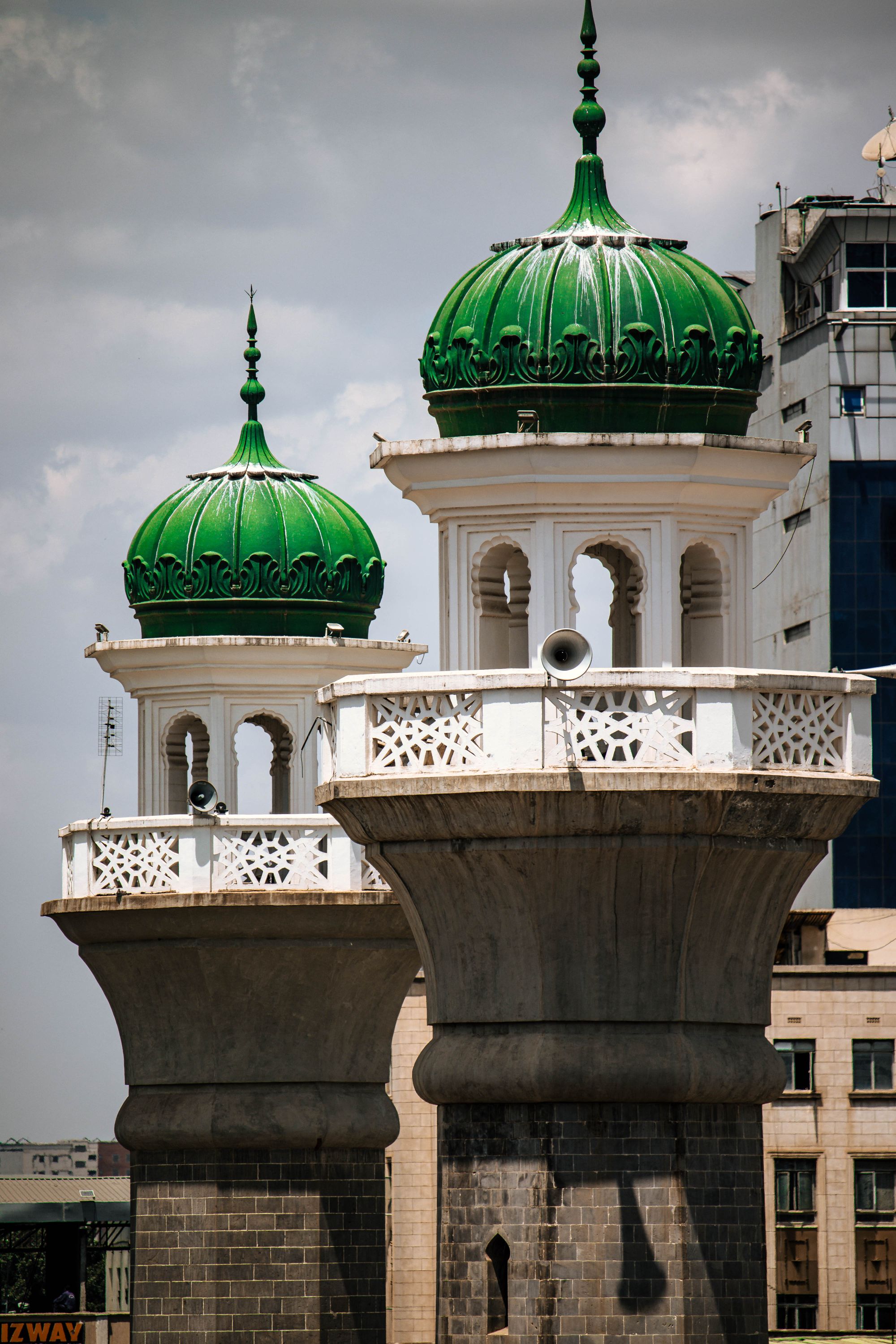
Jamia Mosque is the principal mosque of Nairobi, standing on Banda Street at the northern edge of the Biashara Street and City Market quarter. It was built in 1925, which places it among the older permanent buildings of the centre, and it is the congregation the city's Muslim institutions are organised around. Three silver domes and twin minarets mark it from a distance. This is a working place of worship first and a piece of architecture second, and the page treats it in that order.
The building sits on the list of things to do in the CBD because it is genuinely one of the centre's significant buildings, not because it runs a visitor programme. The 1925 date puts it in the same short run of years as the McMillan Memorial Library further down Banda Street. Together they give this quiet street more architectural weight than its width suggests. The mosque closes the block to the south, the library to the north, and the market hall sits behind.
What the site says about it is short: three silver domes and twin minarets in Banda Street, built in 1925 and the principal mosque of the city, with visitors received outside prayer times and modestly dressed. That is the whole of the promise, and it is accurate. There is no exhibition, no shop and no guided tour to sell. What there is, is a large and handsome working mosque on a narrow street, and the chance to stand at the gate and look, if the timing is right.
02What there is to see
The three domes are what you notice first from Banda Street. They are silver, which reads as pale grey against the sky for most of the day, and they are set above the roofline rather than in a cluster at one point, so the building presents them along its length as you walk. On a narrow street the effect is closer and more abrupt than in a photograph. The twin minarets stand at the corners and carry the same pale finish.
The minarets are the vertical answer to the domes and they give the facade its symmetry. Banda Street is tight enough that you will see them at an angle for most of the approach and full-on only when you are nearly at the gate. The courtyard and gate sit at street level, and the gate is the boundary that matters: this is where a visitor stands, and where asking is the right move rather than walking through.
The prayer hall is seen from outside. Nothing here involves going in, and the architecture is readable from the street and the gate: the domes, the minarets, the arched openings of the facade, the pale stone and the scale, which is bigger than the street around it prepares you for. Set aside a short while, around the time label this page carries, and treat it as a pause in a walk through the market quarter rather than a destination with an itinerary.
The three domes
Three silver domes rise above the Banda Street roofline, the middle one larger than the pair flanking it. They are the clearest landmark in the quarter and visible from the Kenyatta Avenue junction.
The twin minarets
Two slender minarets stand at the corners of the main hall. From the street, the height of them and the contrast with the low shopfronts around are the point of the building.
The courtyard and gate
The entrance courtyard is where visitors are received outside prayer times. Ask at the gate rather than walking further in, and wait to be shown where you may stand.
Prayer hall from outside
The prayer hall itself is for worshippers. What a visitor sees is the exterior mass, the dome line and the courtyard, which is the honest extent of an architecture visit here.
03Reaching it from the grid
The mosque is short work from the commercial grid. From Kenyatta Avenue at Moi Avenue the distance is 0.63 km, and on foot that is 8 min at an ordinary pace. The route runs north and slightly west, and it is flat the whole way. The last stretch is the quietest: Banda Street narrows, the traffic noise drops, and the mosque announces itself by the domes rather than by any sign.
On foot is the right way to do this. Driving into the quarter is a mistake, because the streets are narrow, parking is street-side and usually full, and you would spend longer looking for a space than the walk takes. If you are coming from further out, take a matatu or a taxi to the edge of the grid and walk the last part; agree the fare before you get in. The pavements are shaded for most of the day.
Pair the approach with the streets it passes through. Biashara Street and Muindi Mbingu Street are both within a few minutes, and the City Market hall sits between them and the mosque. A sensible order is cloth first, market second, mosque last, since the mosque is the one stop where a low voice and covered shoulders matter. The quarter is a daytime one, and the halls and streets empty in the late afternoon, so build the walk around the middle of the day or earlier rather than after the offices close.
04Before you go, and the caveat
Sort out dress before you leave the hotel, not at the gate. Covered shoulders and knees are the baseline, and women should carry a scarf for the head before approaching. This is a working place of worship, so voices low and phones away inside the compound, and asking at the gate about access rather than walking into the courtyard unannounced. Prayer times set the day here, and Friday midday is the one window to avoid, when the mosque is fullest and visitors are not received.
Combine the stop with the market quarter while you are there: Biashara Street and the City Market hall are all within a few minutes on foot, and the McMillan Memorial Library is at the other end of the same street. The quarter is a daytime one, so this is not an evening plan. The mosque sets its own arrangements and they move with the prayer calendar, so the current position is best confirmed with the Jamia Mosque Committee or at the gate on the day.
This page is compiled from published information and the site's own checks rather than from a visit. Opening hours, visitor times and anything that moves week to week are not printed here, for that reason and because the operator changes them. The ticket label is Free, donations: a label, not a price. A gift at the gate is customary, and the amount is a matter for the visitor. What does not move is the building, and the building is worth the walk.
- Dress modestly: covered shoulders and knees, and women should carry a scarf for the head before approaching the gate.
- Avoid Friday midday, when the mosque is fullest and visitors are not received; another weekday is calmer.
- Ask at the gate about access rather than walking into the courtyard unannounced, since prayer times set the day.
- Keep voices low and put phones away inside the compound, as this is a working place of worship first.
- Combine the mosque with Biashara Street and the City Market hall, all within a few minutes on foot.
What this page does not print
No opening hours, no visitor times and no entry price are printed here, because the mosque sets its own arrangements and they move with the prayer calendar. The ticket label is Free, donations, which is a label rather than a price: a gift at the gate is customary and the amount is a matter for the visitor. Check the current position with the Jamia Mosque Committee or ask at the gate on the day.
05Who it suits, and the verdict
This suits the traveller already walking the CBD and interested in what the centre actually is: the market quarter, the cloth streets, the 1925 mosque closing the block. It suits anyone prepared to dress modestly, keep quiet, ask at the gate and accept that the answer may be no at that hour. It does not suit anyone treating it as a ticketed attraction with a fixed slot, or anyone wanting to walk through a prayer hall as a sight.
It also does not suit a tight schedule. The visit depends on the prayer calendar, and this page cannot promise the gate will be open to visitors when you arrive. Build slack into the day, and if the timing is wrong, the library, the market hall and Biashara Street are all within a few minutes and worth the time on their own. The mosque is the anchor of the walk rather than the whole of it.
The verdict: go, on foot, modestly dressed, in the middle of a market-quarter morning, and ask at the gate. Keep expectations at the level the building deserves, which is a working mosque of 1925 with three silver domes and twin minarets on one of the quietest good streets in the centre. That is enough. The architecture is read from the street and the gate, and the stop takes about as long as the label suggests, which is 30 min.
Where this page comes from
Desk research, not fieldwork. Nobody writing this stood on the corner with a stopwatch, and a page that implied otherwise would be the least trustworthy thing on the site. The specifics above came from here:
- Jamia Mosque: Jamia Mosque Committee, visitor guidance.
- Jamia Mosque: the mosque’s published visitor guidance.
- Opening arrangements: the National Museums of Kenya, Kenya National Archives, KICC and Jamia Mosque visitor information.
Opening hours, ticketing and market days change. No hotel or operator pays to appear here.
06Questions
Can I go inside Jamia Mosque?+
Visitors are received outside prayer times, and modest dress is required. The prayer hall is for worshippers, so what a visitor sees is the courtyard and the exterior. Ask at the gate rather than walking in, and follow the direction you are given.
What should I wear to visit?+
Covered shoulders and knees are the minimum, and women should carry a scarf for the head. Shoes come off at the appropriate point. Dress for a place of worship rather than a tourist site, and the visit is straightforward.
Is there an entry fee?+
The ticket label for this page is Free, donations. No price is printed here or anywhere on this site, because the mosque sets its own arrangements. A gift at the gate is customary and the amount is a matter for the visitor.
When should I avoid coming?+
Avoid Friday midday, when the mosque is at its fullest and visitors are not received. Other weekday prayer times also close the courtyard to visitors for a period. A weekday outside prayer is the calmest option.
How do I get there from Kenyatta Avenue?+
The mosque is about 0.63 km from Kenyatta Avenue at Moi Avenue, a walk of roughly 8 min north through the market quarter. It stands on Banda Street, at the end nearest Biashara Street. Walking is easier than driving, as the streets are narrow.