01What this walk actually is
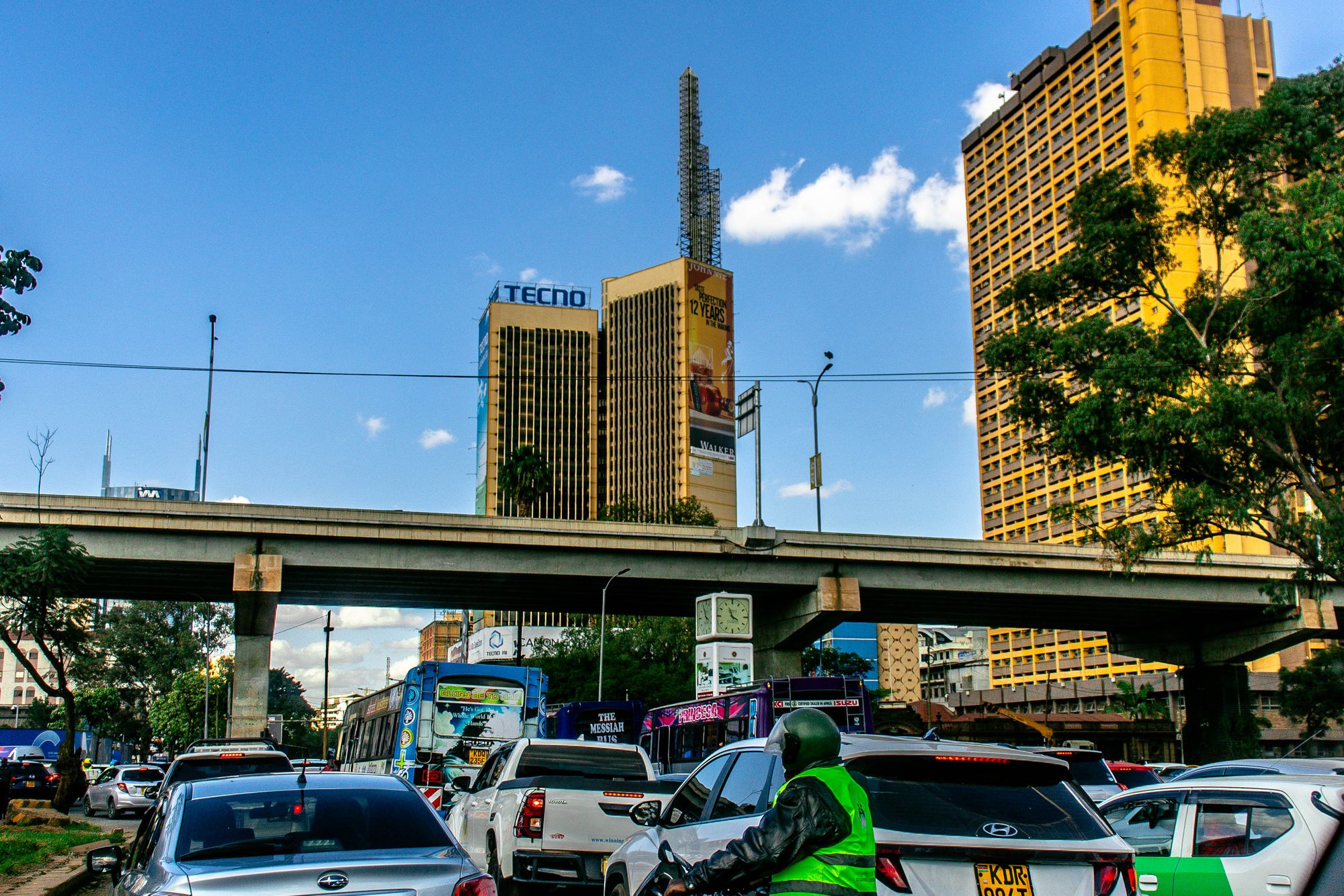
This is not a heritage trail or a shopping route. It is one straight pavement, done end to end in daylight, and it is the fastest way to understand how the CBD fits together. The avenue runs north from the railway side to the Globe, and Tom Mboya Street runs parallel one block east. Between them they take more pedestrians than any other pair of streets in the country. The traffic is the point, not an obstacle. Almost nobody on it is sightseeing, which is exactly what makes it worth doing.
The walk is the avenue itself: pavement, crossings, shopfronts, touts, preachers, and the National Archives sitting mid-way at the Hilton corner in the old Bank of India building. The distance from Kenyatta Avenue to the Archives corner is 0.27 km, about 4 min on foot, so this is not a route with a beginning and an end so much as one continuous block of city life you can step into at any point. Most people who do it properly spend around 1 hour on the avenue, stopping where something holds them.
The site lists it as Free, meaning no ticket is bought to walk it. The Archives is a separate matter and has its own desk. Do not treat this as a checklist. The avenue rewards the opposite: slower walking, fewer stops, and attention to what is actually happening on the pavement. It is the busiest pavement in Kenya, end to end, and it is the clearest one-hour introduction to the centre that a visitor can take on foot.
02What there is along the avenue
The row list above names four things, and they are not equal. The pavement is the main event: the crowd, the hawkers, the phone kiosks, the preachers, and the matatu stages at both ends that have no signage but a strict internal order. The Archives is the one indoor stop that justifies going inside. The bookshops and news stands are the thread that holds the older retail character of the avenue together. The stages explain how the city moves. Read the list as a sequence of reasons to slow down, not as a set of attractions.
The Archives is the only entry that asks anything of you. It occupies the old Bank of India building at the Hilton corner, and behind the banking-hall columns is the Murumbi collection: African art, textiles, beadwork and photographs, stacked floor to ceiling. That collection alone makes the avenue more than a thoroughfare. Ticketing arrangements and photography rules are set by the operator, posted at the desk, and enforced, so the practical move is to ask there rather than to assume.
The bookshops and news stands along Moi Avenue are the best in the city, and they are still working shops, not relics. The matatu stages are where the avenue is loudest and most legible: watching one work for ten minutes explains the city faster than any sign. The Hilton roundabout sits at the southern end as the orientation point for the whole eastern grid, visible from most of these streets. None of this needs a ticket, and none of it needs long. It needs daylight and a willingness to stand still.
The pavement itself
Hawkers, matatu touts, phone kiosks, preachers and a bus every few seconds. Almost nobody on it is going anywhere in particular, which is the point: this is where the city shops, eats lunch and changes buses.
The Archives
The Kenya National Archives sits mid-avenue at the Hilton corner in the old Bank of India building. Ticketed, roughly an hour inside, and the Murumbi collection of African art, textiles and beadwork is the reason to stop.
Bookshops and news stands
Several of the old bookshops survive along the avenue, and the news stands here carry the widest range in the centre. Street level is shops; everything above is offices.
The matatu stages
The informal stages at both ends have no signage and a strict internal order. Watching one work explains more about how the city moves than any single building on the street.
03Reaching it from the grid
The avenue sits in the eastern half of the grid. From Kenyatta Avenue at Moi Avenue the walk to the Archives corner is 0.27 km and about 4 min, which means almost anywhere in the centre is within a short walk of the avenue. Tom Mboya Street is one block east and runs parallel; Kimathi Lane and Muindi Mbingu are the short cross streets that link the busy grid to the market quarter. On foot these crossings are quicker than any vehicle at any hour. Treat the avenue as a spine you join, not a destination you arrive at.
Vehicles move slower than walkers on both streets for most of the day, so a car is a hindrance rather than a help for this. The matatu stages at both ends of the avenue are the busiest points, and they are also the places where you are most likely to be approached. The practical approach is to walk the avenue from the Kenyatta Avenue end, cross at the Hilton roundabout, and continue north until the crowd thins or you have had enough. There is no correct direction, but starting at the wide southern half puts the Archives mid-route.
The round trip is short: 1 hour covers the avenue at an unhurried pace and a stop inside the Archives if it is open. If you are coming from the railway end, the avenue is the first street you meet and the walk north is straightforward. If you are coming from the market quarter, use the Muindi Mbingu crossing and join the avenue at the Archives corner. Do not plan a loop that depends on a vehicle. The grid here is small enough that walking is always the faster answer in daylight.
04Before you go, and one caveat
This page is compiled from published information and the site's own checks rather than from a visit. Opening arrangements and anything that moves week to week, including the Archives' hours, its ticketing, its photography rules and hawker enforcement along the avenue, are not printed here. Ask at the Archives desk on the day, or check with the operator before setting out, rather than trusting a printed hour. The bullet list above carries the practical rules that do not move: daylight, one pocket, nothing in your hands, and no arrangement with anyone who approaches you on the pavement.
The walk is Free and takes about 1 hour. What you need to sort out is smaller than it sounds. Keep one pocket in use and buy only from premises you chose yourself. Walk in daylight and leave before the pavement thins after the evening commute. Treat a car as a hindrance, not help. If the Archives is the reason you are coming, ask about ticketing and photography at the desk before you go in, because those rules are posted there and enforced.
The one honest caveat is that the avenue changes with enforcement, not with the calendar. Hawker pressure moves from block to block month to month, which changes how crowded a stretch feels and how quickly you can walk it. The Archives keeps its own hours and sets its own rules. Neither is printed here because neither is fixed. What does not change is the pavement, the shops at street level, the offices above, and the volume of people. Plan around that, and the rest of the walk takes care of itself.
- Keep one pocket in use and nothing in your hands; the crowd is not the risk, being distracted inside it is.
- Walk the avenue in daylight and leave before the pavement thins after the evening commute, when it empties fast.
- Vehicles move slower than walkers on both streets for most of the day, so treat a car as a hindrance rather than help.
- Ask at the Archives desk about ticketing and the photography rules, which are posted there and enforced.
- Agree nothing with anyone who approaches you on the pavement, and buy only from premises you chose yourself.
What this page cannot tell you
Hawker enforcement moves street trade from block to block month to month, so how crowded any given stretch feels changes with it. The Archives keeps its own hours and sets its own ticketing and photography rules, and those move too. Ask at the desk on the day, or check with the operator before setting out, rather than trusting a printed hour.
05Who it suits, and the verdict
This suits anyone who wants to understand the CBD on foot in a single stretch of daylight. It suits the traveller with a spare hour and no fixed plan, the person who wants to see how the city actually moves, and anyone heading to the Archives who wants the avenue as the approach rather than a taxi drop-off. It does not suit anyone looking for a quiet stroll, a curated heritage route, or a place to sit. The avenue is loud, packed and non-stop, and it is not trying to be otherwise.
The verdict is straightforward: do it once, in daylight, end to end. Start at the Kenyatta Avenue end, walk north, stop at the Archives if the desk is open, and carry on until the crowd thins. Keep one pocket in use and nothing in your hands. Do not try to combine it with a car, and do not leave it until after the offices close, when the pavement empties fast. This site would send a first visit to the avenue before almost anything else in the grid, because it explains the rest of the centre better than any single building does.
What you get for that hour is not a monument. It is the working texture of the city: shops at street level, offices stacked above, matatu stages at both ends, bookshops, news stands, phone kiosks and the Archives in the middle of it. That is the whole proposition, and it is enough. The avenue is the busiest pavement in Kenya, end to end, and doing it once in daylight makes the rest of the grid make sense. Go for that, not for a list of sights, and the walk will hold up.
Where this page comes from
Desk research, not fieldwork. Nobody writing this stood on the corner with a stopwatch, and a page that implied otherwise would be the least trustworthy thing on the site. The specifics above came from here:
- Distances: computed from published coordinates, direct line from Kenyatta Avenue at Moi Avenue.
- Street naming and the colonial grid: Nairobi City County and National Archives published histories.
- Street-level safety guidance: current travel advisories for Nairobi, checked against the operator advice given at the stages.
Opening hours, ticketing and market days change. No hotel or operator pays to appear here.
06Questions
Can I walk Moi Avenue on my own?+
Yes, in daylight, and it is the easiest introduction to the centre on foot. Keep one pocket in use, hold nothing loose, and do not stop in the middle of the flow to check a phone. The crowd is not the risk; distraction inside it is.
Is the National Archives on the avenue worth stopping for?+
It is the one indoor stop worth building into the walk, and it sits mid-avenue at the Hilton corner. Ticketing and photography rules are set by the operator and posted at the desk, so ask there rather than assuming. The Murumbi collection is the reason to go in.
How do I get there from the rest of the grid?+
The avenue starts a short walk from Kenyatta Avenue at Moi Avenue, which is the natural entry point from the western grid. Walking beats driving here: vehicles move slower than pedestrians on both Moi Avenue and Tom Mboya Street for most of the day.
What should I leave behind?+
Anything you would mind losing in a crowd, and anything you would have to hold in your hands. One pocket, nothing loose, nothing on display. If you are carrying a bag, wear it where you can see it rather than on your back.
Is it safe after dark?+
The quarter thins out fast after the evening commute and is better avoided late. Take a car after dark rather than walking the avenue. Current travel advisories for Nairobi are worth reading alongside this page, not instead of it.