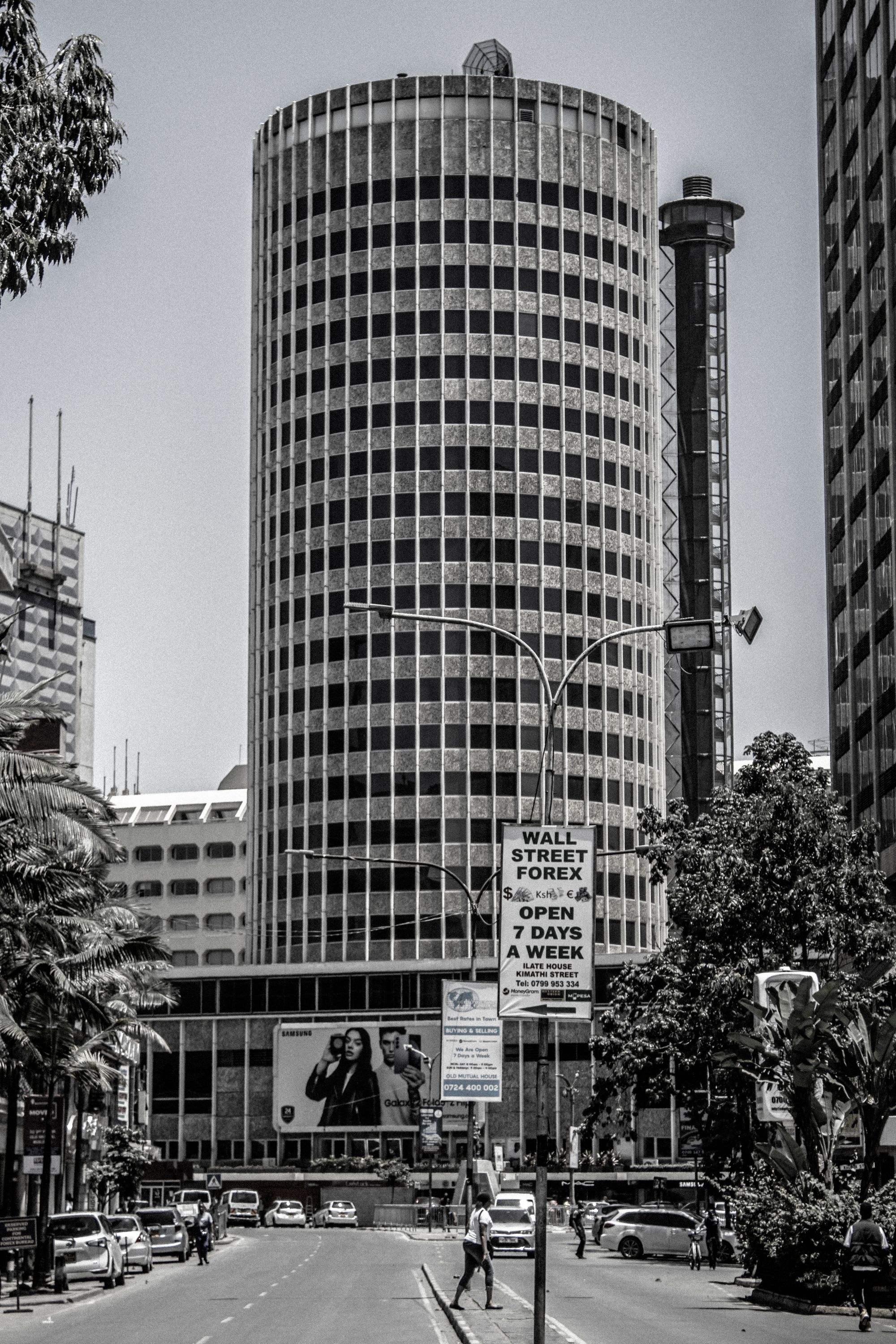
01Why the upper floors matter here
Nairobi's centre is usually read at eye level and below: the shopfronts, the hawker rows, the awnings, the pavement. That habit costs you the best thing in the district. The old retail streets were built as complete buildings, and the part above the modern signage is often the part nobody has repainted, re-clad or replaced. Walk Moi Avenue or Biashara Street looking straight ahead and you see a working African commercial city. Look up and you see a colonial one, still carrying its ornament.
The upper floors survived by being uneconomic to touch. Ground floors were subdivided into phone shops, kiosks and stairwell arcades because that is where the money is. Upper floors were left to offices, storage and slow conversion, which meant the parapets, cornices, window bays and stepped rooflines of the 1930s were never stripped off and replaced. The result is unusual for a capital city: a continuous run of period fronts a few metres above the trading floor, passed by tens of thousands of people daily and noticed by almost none of them.
This matters beyond nostalgia. The upper frontages are the clearest available record of how the centre was designed as a commercial town rather than as a colonial administrative showpiece, street by street and block by block. They also explain the shape of the streets you are walking: why Biashara is narrow, why the market hall sits where it does, why the lanes between are the width of a cart. Read the fronts and the grid stops being arbitrary.
This page is about looking, not about inventory. It sets out where the surviving frontages concentrate, what has replaced the ones that did not survive, and how to read a facade from public pavement without a guide, a ticket or a tour. It is written for the reader who is already in the district on other business and has a spare half hour. That is the right frame. The fronts are not an attraction in the usual sense. They are part of the walk you were already taking.
02What is up there, street by street
Biashara Street frontages are the most continuous of the lot. The street is the oldest retail street in the centre still doing what it was built for, narrow, shaded, and lined with shops a single business wide. That narrowness is what protected the upper floors: nobody has been able to assemble a big enough footprint to justify demolition and redevelopment. Above the cloth, haberdashery and school outfitters you get run after run of the same period, parapets and cornices largely intact, interrupted mostly by paint and by the signage brackets bolted on since.
Moi Avenue and Tom Mboya Street carry the opposite condition. Here the frontages are grander and the losses are greater. Whole blocks have been rebuilt or re-clad, and what survives sits between them in short stretches, usually above a bank hall or an older office entrance. The compensation is scale: where a frontage survives on Moi Avenue it tends to be a full commercial facade, cornice to trading floor, rather than the shop-width runs of Biashara. Read this pair as fragments, and read Biashara as a sequence.
The Archives block at the Hilton corner is the anchor. The Kenya National Archives occupies the old Bank of India building, and its front is the most legible single piece of period commercial architecture in the district, columns and banking-hall manner included. It is also the one front on this list you can walk into rather than only look at. Treat it as the fixed point for orientation: everything else on the avenue can be read by reference to it.
The lanes between are the fourth category and the easiest to miss. The short cross streets linking the busy grid to the market quarter hold the back and side elevations of the same buildings, and side elevations are often less altered than fronts because fewer people look at them. Alley walls, service doors, stair towers and blind upper windows survive here in a way street fronts do not. This is where surface, brick and window rhythm survive.
Biashara Street frontages
Narrow shopfronts a single business wide, with original upper floors above the awnings and signs. Look for the shallow balconies, metal casements and decorative parapets, several still legible under later paint.
Moi Avenue and Tom Mboya
The busiest pavements in the centre, where upper floors are easiest to see from a shop doorway. Ground floors have been subdivided into phone shops and kiosks, but the floor above often still reads.
The Archives block
The former Bank of India building carries confident columns at street level and a banking hall inside. It is the most legible single frontage on the avenue and the easiest to read from the pavement opposite.
The lanes between
Short cross streets and stairwells carry the less obvious fronts. Walk them in daylight, keep to the street side of the pavement, and let the upper storeys do the work.
03What this page cannot tell you
The honest limits first. No survey of every upper floor in the centre has been published, and this site has not carried one out. Building dates, architects and survival rates vary from block to block, and repainting, signage and upper-floor conversion change what is visible from year to year. Published architectural histories cover some named buildings in detail and leave the rest to general description. Treat what follows as a way of looking, not an inventory, and check the desk or the building owner before printing any single date as settled.
That caveat is not modesty, it is method. This page is compiled from published information and the site's own checks rather than from a visit. Nobody writing it has stood on these pavements. Opening arrangements, and anything that moves week to week, are not printed here, because they move: gate hours, access to stairwells, whether a given upper floor is occupied, whether a facade is currently under scaffold. Ask on the day rather than planning around a printed time.
The bullet list above is the practical half of the same problem. Perspective flattens upper floors from directly below, so the reading position matters more than the route. Private stairwells are private, however inviting the doorway. Signage and awnings change the face of a building faster than anything structural does, which means any description here is provisional by design. And cameras attract attention in a crowd in a way eyes do not.
What the page also cannot do is rank. There is no defensible order to these frontages, because survival is patchy and taste runs differently street by street. A reader who wants a number from one to four is asking the wrong question. The right question is which street you are already on and what is directly above you, which is a question only the pavement can answer.
The callout on this page repeats the sourcing point in the site's own words, and it is worth reading before quoting anything from this page. The short version: the site prints no price of any kind, names no hotel and no restaurant, and asserts no opening hour. Institutions of the city may be named. Everything else is a way of looking.
- Stand on the opposite pavement, not directly below the building, or the upper floors disappear into perspective.
- Do not enter private stairwells or lean over balconies; read the fronts from public pavement only.
- Signage, paint and awnings change the face of these buildings often, so treat any description as provisional.
- Photograph from doorways and shop fronts rather than mid-pavement, and keep a phone or camera in a pocket between shots.
What this page cannot say
No survey of every upper floor in the centre has been published, and the site has not carried one out. Building dates, architects and survival rates vary from block to block, and repainting, signage and upper-floor conversion change what is visible from year to year. Published architectural histories cover some named buildings in detail and leave the rest to general description. Treat what follows as a way of looking, not an inventory, and check the desk or the building owner before printing any single date as settled.
04How to walk it, and when
Take the grid origin at Kenyatta Avenue and Moi Avenue and work north and west on foot. The market quarter lies to the west, two minutes north of Kenyatta Avenue, with the busy grid running north from the origin itself. That gives you one sensible loop without a plan: up Moi Avenue and Tom Mboya Street on the east, across the lanes, then down Biashara and the market streets on the west. You are never more than a short walk from where you started.
Walk it in daylight and in the working day. This is a daytime district in the plainest sense, and the frontages are read best when the light is on them and the shutters are up. Early morning and mid-afternoon both work; the middle of the day is hottest and the pavements fullest. After the offices close the streets empty street by street, and there is nothing to look at in the dark anyway.
Read from the opposite pavement, not from directly beneath the building. The whole discipline of the walk is standing back far enough to see cornice, window bay and parapet in one frame, then crossing to read the next front the same way. Keep moving, keep your hands free, and keep a phone or camera in a pocket between shots. Photograph from doorways and shop fronts rather than mid-pavement. The crowd is not the risk; distraction inside it is.
For a first visit this site would send you to Biashara Street, because it is the one continuous sequence and the easiest place to learn what you are looking at. Then Moi Avenue for the Archives block, and the lanes last, once your eye has something to compare them against. The lanes reward a second pass more than a first one. If you only have time for one street, make it Biashara, and look up for the length of it.
Where this page comes from
Desk research, not fieldwork. Nobody writing this stood on the corner with a stopwatch, and a page that implied otherwise would be the least trustworthy thing on the site. The specifics above came from here:
- Street naming and the colonial grid: Nairobi City County and National Archives published histories.
- Architectural attribution: published architectural records for the 1973 building.
- Current travel advisories for Kenya: your own government’s published advice, which is updated and dated.
Opening hours, ticketing and market days change. No hotel or operator pays to appear here.
05Questions
Can I just walk in and look at the upper floors?+
The fronts are visible from public pavement, so the walk itself needs no ticket and no arrangement. Interiors of working buildings are a different matter: the Archives gallery is ticketed at the desk, and private offices and stairwells are not open to passers-by. Ask at a shop or an office door if a particular building interests you.
Is there a single route that takes in the best of them?+
There is no official route and this page does not print one. The practical approach is to work the two parallel streets and their cross lanes in daylight, reading the upper floors from the opposite pavement, and to treat Biashara Street as the densest stretch. Direction matters less than getting the sightline right.
Why are no dates and no opening hours printed here?+
Building dates for the centre are recorded unevenly, and the site prints a year only where the record supports it. Opening hours are set by each operator and change with the seasons and with staffing, so a figure printed here would go stale. Check with the desk or the operator on the day, and treat the walk as a daytime activity.
Is the walk safe on foot?+
These are working streets with heavy pedestrian traffic through the middle of the day, and they empty quickly after the offices close. Walk them in daylight, keep valuables out of sight and in a pocket, and take a car rather than walking after dark. Current travel advisories are the right place to check before you go.