01The civic block, open and guarded
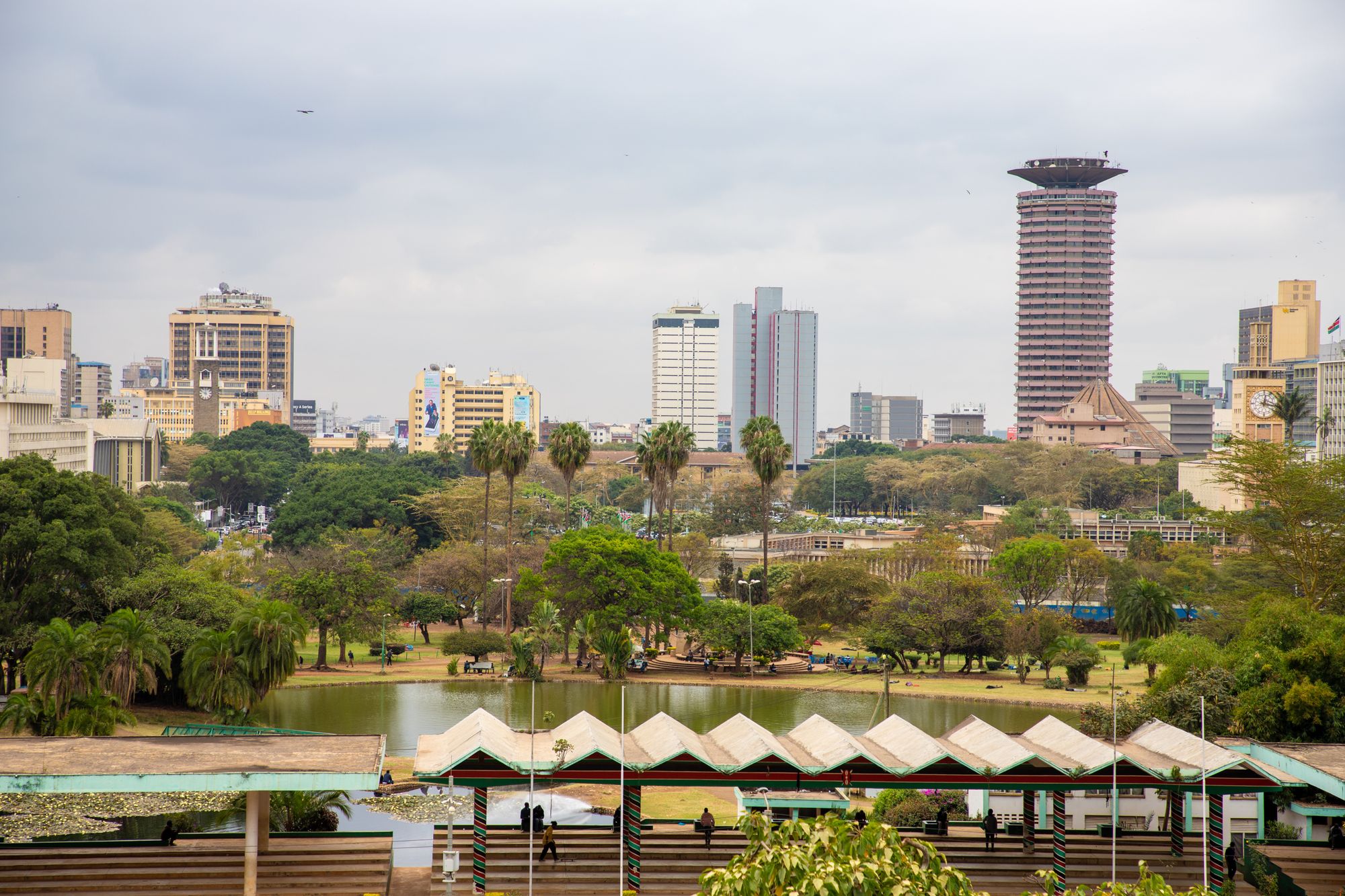
City Square is the state's block and the most legible ground in the Central Business District. Parliament on one side, the Supreme Court and City Hall on the others, the mausoleum of the first president behind its railing, the Holy Family Basilica facing the paving: all of it arranged to be looked at from the same spot. The paving is closed to through traffic and carries no hawker pressure, which makes it the one place in the centre where you can stand still without being in someone's way. The Kenyatta International Convention Centre rises out of it, a 28-storey cylinder finished in 1973 with an amphitheatre at its foot and a helipad deck on the roof that the public may stand on. The tower is the reason to come; the square is the reason to stay longer than the lift takes.
What you meet at ground level is a place that runs on appointment and permission rather than on passing trade. The KICC deck is ticketed at a ground-floor desk, and identification is asked for; the deck closes in bad weather and can close for state events without notice, so the gate is where to ask on the day. The basilica, a concrete hall of the 1960s, is open between services and is often empty on a weekday afternoon. Parliament admits visitors through its own programme by arrangement. The mausoleum is guarded and is viewed from outside the railing. The pattern is consistent: things here are entered by asking, not by arriving.
The block has been a set piece since the 1930s, when the Law Courts and City Hall gave the quarter its civic frontages. The basilica came in the 1960s and the mausoleum in 1978, after the tower. Nothing about the arrangement is accidental: the flags, the mausoleum and the cathedral opposite were all placed to be seen from the same open ground, and the result is the only part of the grid that was planned as a composition rather than allowed to happen. Walk City Hall Way along the southern edge, where government traffic is heavy on weekday mornings, or Harambee Avenue along the ministries, where the pavement is easy but the camera is not always welcome. Taifa Road cuts back past the KICC entrance and the car park.
This site would send a first visit here in daylight and on foot, because the square is institutional and closes with the working day. After the offices empty, the lit emptiness feels stranger in this quarter than anywhere else in the centre, and there is nothing open to sit in. The walk between the civic landmarks is short and the surface is the best in the centre. Treat the block as a morning or an early afternoon, take the lift while the deck is open, and keep the photography to the roof, where it is expected. Around Parliament and the ministries, ask first or leave the camera down. That is not a warning about danger; it is how the block works.
02The market streets, narrow and shaded
The computed direct line from Kenyatta Avenue at Moi Avenue to the market quarter measures 0.63 km and about 8 min, and it is worth saying plainly what that line is: a line, not a route. It crosses buildings, courtyards and a mosque. The walkable version is shorter in feel and different in kind, because the two ends of it belong to different cities. City Square is open, planned and institutional. Biashara Street is narrow, shaded and lined with single-family shops selling cloth, haberdashery, children's clothes and fabric by the metre. It is the oldest retail street in Nairobi still doing what it was built for, and the Swahili name simply means business.
The row list in front of you names the sequence: open paving at City Square, the tower and its deck, Biashara Street's shopfronts, City Market and Jamia Mosque. What the sequence hides is how quickly the architecture changes hands. You leave the concrete cylinder and the flags and arrive, a few minutes north, among shopfronts the width of one business, with tailors upstairs and cloth stacked to the ceiling. Muindi Mbingu Street runs beside Biashara and carries the flower sellers at the City Market door; the produce entrance sits beyond them and is busiest mid-morning, when hotels and offices buy. Banda Street holds Jamia Mosque at one end and the McMillan Memorial Library, behind its marble lions, at the other, and is the quietest good street in the centre.
The market hall itself is a 1930s art deco shed of deck-and-arch construction, built as a produce market and still one. Produce occupies the centre, a fish counter sits at the back, and curio stalls fill the upper gallery. Jamia Mosque, built in 1925 and the principal mosque of the city, closes the block to the south with three silver domes and twin minarets. Between the mosque, the library of 1931 and the market hall, this quarter holds more of the city's architectural history per hundred metres than anywhere else in the grid, and it holds it in working buildings rather than in a preserved set. The streets are narrow and shaded for most of the day. Driving into the quarter is a mistake: parking is street-side and full.
The verdict on this half is simple. Give it an hour on foot and go in the middle of the day, because the halls shut in the late afternoon and the shutters come down street by street with them. Produce is a morning business and the trade thins well before the streetside shutters do. Cloth bought here can be made up by a tailor upstairs or next door, so agree the work and the timeline in the shop before leaving, and expect days rather than hours. The quarter rewards slowness and punishes the checklist. It is also the half of the crossing where the district still looks like the commercial town that grew beside the railway, which is the reason to walk it rather than ride it.
Open paving at City Square
The state's block: Parliament, the Supreme Court, City Hall, the mausoleum and the convention centre. Flags, low traffic and the widest walking surface in the centre. It empties when the offices close.
The tower and its deck
The 1973 cylinder anchors the quarter and its rooftop deck is the reason most people come. Tickets come from the desk downstairs, the lift does most of the climb, and the deck closes for weather and state events.
Biashara Street's shopfronts
The oldest retail street still doing what it was built for: cloth, haberdashery and school outfitters, each shop the width of one family business. Tailors work upstairs and take days rather than hours.
City Market and Jamia Mosque
A 1930s produce hall with flowers at the door, a fish counter at the back and curios in the upper gallery. The mosque's three silver domes close the block to the north. Both are daytime places.
03What this crossing cannot tell you
The honest half of this page is the part that admits its limits. A crossing of this kind cannot tell you what will be open when you arrive, because the things that matter here move week to week. The KICC deck closes in bad weather and for state events without notice. The basilica opens between services. Jamia Mosque receives visitors outside prayer times. The library has been restored in phases and its doors follow that work. City Market and the produce trade inside it follow the trading day, not a visitor's day. That is why this page prints no opening hour and no closing hour, and no price of any kind, including fares, entry charges and plate prices. Live arrangements belong to the operator, and the operator is the only place to confirm them.
The crossing also cannot tell you what a line on a map always hides: that a direct line between two points is not a route. The figure of 0.53 km and about 7 min from the origin to City Square, and 0.63 km and about 8 min to the market quarter, describe distance and nothing else. They do not describe pavement quality, shade, security gates, crowds at the flower stalls or the fact that the market quarter's streets are too narrow for a car to be useful. Do not turn the figures into an itinerary. Do not add them together and call it a walk. Read them as two separate short crossings from the same corner, and choose one.
The awkward questions have short answers. Is the line a walking route? No: it is a line, and the walkable crossing is a different thing. Can the whole crossing be done in one go? It can, in daylight, but not at the pace the map suggests, because the two halves keep different hours and the second half closes while the first is still standing. What should be asked about before setting out? Whether the deck is open, whether the mosque is receiving visitors, whether the market hall is trading. Which half suits limited time? The market quarter, because it is compact, shaded and self-contained. All of this is compiled from published information and the site's own checks, not from a visit, and anything that moves week to week is not printed here.
The bullet list in front of you is the concrete version of the same caveat, and the callout above restates the policy. Nothing in this crossing is bookable through this page, and no hotel or operator pays to appear here. The reliable move at every gate, desk and shopfront is to ask on the day, and to accept that the answer may be no. Where a cost matters, ask the operator; where a time matters, ask the gate; where a bargain matters, walk away once and come back. This page's judgement is that the crossing is worth making precisely because the two halves disagree with each other, and that the disagreement is the content. It will not pretend to settle questions that the district itself settles by the hour.
- Ask at any gate before photographing near Parliament or the ministries; security is real and the camera is better kept down along Harambee Avenue.
- Cloth bought on Biashara Street can be made up by a tailor upstairs or next door, so agree the work and the timeline in the shop before leaving.
- In the City Market curio gallery the first figure and the settling figure are far apart, which is expected: walk away and come back before agreeing.
- Reach the market quarter in the morning if the produce hall matters, because the trade thins there well before the streetside shutters come down.
What this page does not print
No opening or closing hour appears here, and no price of any kind. The rooftop deck, the basilica, the mosque, the library and both market halls each keep their own hours and change them for state events, weather and restoration, so the reliable move is to ask at the desk or the gate on the day. Fares, entry charges and plate prices sit with the operator, and the operator is the only place to confirm them.
04How to use the ten minutes
Start at Kenyatta Avenue at Moi Avenue in the morning, with the sun behind you, and treat the two halves as two visits rather than one. City Square first, while the deck has the best chance of being open and the light on the tower is good. Ask at the ground-floor desk before going up, bring identification, and accept that weather or a state event may close the roof for the day. Walk the civic block on foot: City Hall Way, Harambee Avenue, Taifa Road. Then take the market quarter in the same outing if the morning is still going, or leave it for another day and give it its own hour.
For the market quarter, arrive from the avenue on foot and leave the car behind. Two minutes north of Kenyatta Avenue the streets narrow and the shade closes over them, and parking is street-side and full, so a vehicle costs more time than it saves. If the produce hall matters, go before the trade thins; the flower sellers on Muindi Mbingu are busiest mid-morning. If cloth matters, go into the shops on Biashara Street, ask about a tailor upstairs or next door, and agree the work and the timeline before you leave the counter. If curios matter, treat the first figure in the gallery as an opening, not a price, and walk the upper level before settling.
Read the row list as a shape rather than a schedule. Open paving, the tower and its deck, the shopfronts, the market hall and the mosque: that is a change of condition, not a set of stops to tick off. The crossing is short enough that the temptation is to rush it, and rushing is what spoils it. The civic block asks for stillness and permission; the market quarter asks for slow walking, bargaining and a willingness to be redirected. Give each half what it asks for and the ten minutes become the most useful short walk in the centre. Try to compress both into a single dash and you will see two places badly.
If time is genuinely short, choose one half and do it properly. The market quarter is the better single choice for a first visit to the district: it is compact, shaded, self-contained, and it holds the mosque, the library, the market hall and the cloth streets inside a few minutes of one another. City Square is the better choice if the view from the tower is the point, since nothing else in the centre replaces it. Whichever you take, ask at the gate, agree the fare before you get on anything, and keep the camera down where the state's buildings are concerned. The crossing rewards the walker who arrives with questions and leaves with fewer, not the one who arrives with a list.
Where this page comes from
Desk research, not fieldwork. Nobody writing this stood on the corner with a stopwatch, and a page that implied otherwise would be the least trustworthy thing on the site. The specifics above came from here:
- City Market and McMillan Library: Nairobi City County heritage listings and the library trust’s restoration notices.
- Distances and walking minutes: computed from published coordinates, direct line at 4.8 km/h.
- Building history and public access: Kenyatta International Convention Centre visitor information.
Opening hours, ticketing and market days change. No hotel or operator pays to appear here.
05Questions
Is the line between City Square and Biashara Street a walking route?+
No. It is a computed straight line from published coordinates, drawn at a steady pace, and it cuts through buildings and closed blocks. The streets do the actual connecting: Kenyatta Avenue east to west, then north up Moi Avenue or Muindi Mbingu Street into the market quarter. Treat the line as a measure of how close the two quarters sit, not as directions.
Can I walk the whole crossing in one go?+
Yes, and it rewards being split. City Square is open, institutional and best in daylight, while the market streets are narrow, shaded and run on a morning and lunchtime rhythm. Most people do the civic block first and the market quarter after, with the avenue between them as the hinge. Both halves close down with the working day.
What should I ask about before setting out?+
Current opening arrangements, because the rooftop deck, the basilica, the mosque, the library and the market halls all set their own and change them. Ask about modest dress at the mosque gate, about identification at the deck desk, and about the condition of the library before walking down Banda Street. This page prints none of those hours on purpose.
Which half suits someone with limited time?+
The market quarter packs more into a shorter stretch: cloth shops, a produce hall, a gallery of curios and a 1925 mosque within a few minutes of each other. City Square is the one place in the centre where standing still is easy, and the rooftop view is the single best reason to be there. Choose by whether the visit is about looking or about buying.