01Why the avenue turns purple
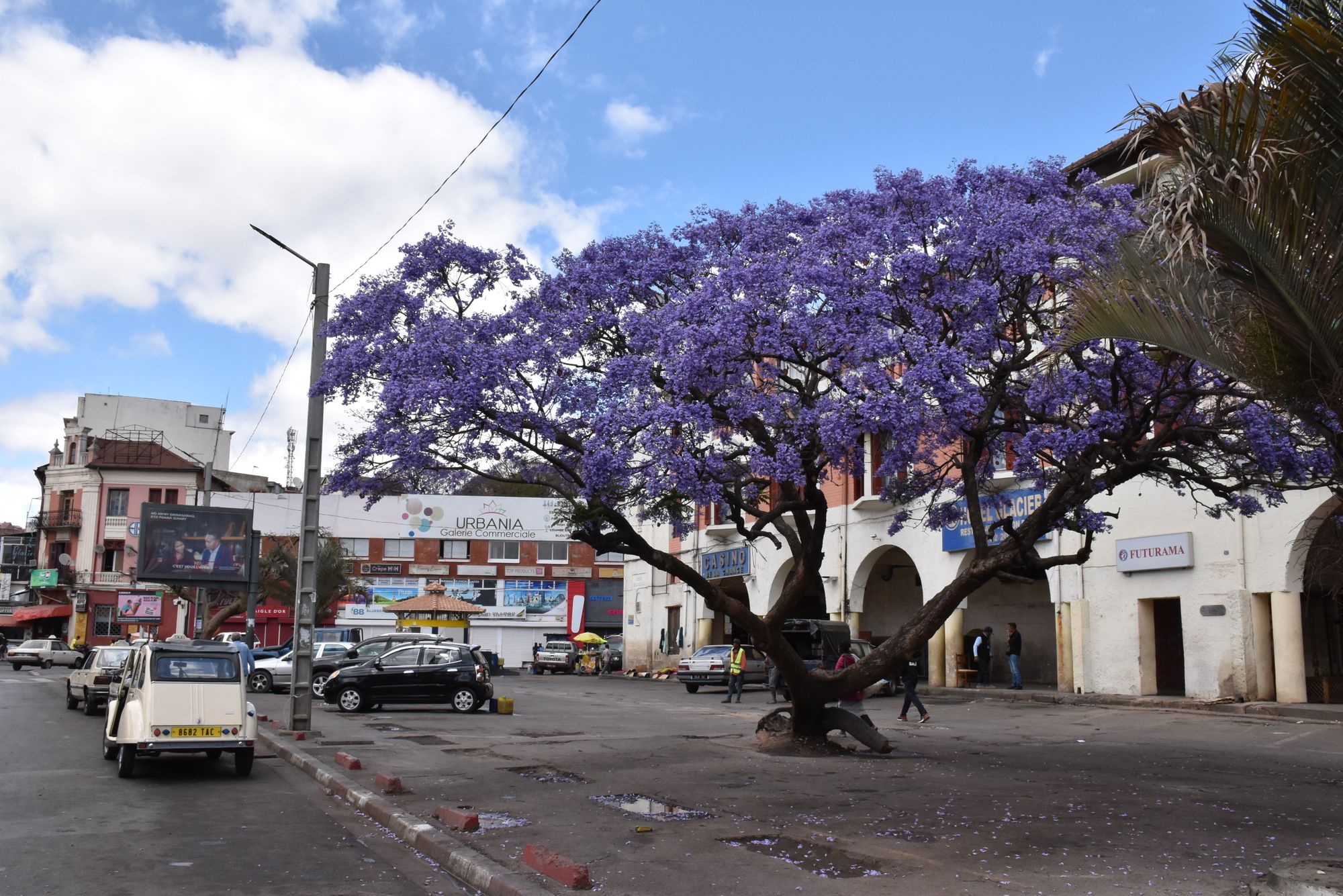
Kenyatta Avenue is the one street in the CBD that changes colour. For a few weeks either side of the short rains the jacarandas planted down the central reservation lose their leaves and put out purple, and the whole spine of the financial district reads differently for as long as it lasts. This is not a garden or a park. It is six lanes of bank headquarters with a line of trees down the middle, and that contrast is the whole point of going to look.
The jacaranda is not native to Kenya. It arrived from South America by way of the colonial planting programmes, and it turns up across the highland towns wherever someone wanted a street to have a colour. What makes the avenue worth a page is not the tree itself but the setting: a planted median running straight between the head offices of most of the country's banks, so the purple sits on top of the most orderly street in the centre.
Why the timing moves is the rain. Jacarandas flower on their own schedule, and that schedule is set by when the short rains arrive and how heavy they are. A dry September and the trees hold back. A wet one and they come early and drop fast. No calendar controls it, which is why any date anyone gives you, including the dates on this page, is a guess dressed up as information.
This page exists because the question is asked every year and answered badly every year. What follows is a rough window, the streets that carry the best of it, and an honest account of what cannot be promised from outside the city. Read it as orientation, not as a schedule. Then ask locally when you arrive and look at the trees yourself.
02Which streets do it best
The display is not spread evenly across the grid, and it is worth knowing which stretch to walk before you set out. The trees follow the planting, the planting follows the avenue, and the avenue is where almost all of it is. The row list above gives the four stretches that matter, in the order this page would take them. What follows is why each one sits where it does.
Kenyatta Avenue itself carries the main line: the median from the Uhuru Highway roundabout in the west to the Moi Avenue junction in the east, with the trees running the length of it. This is the stretch the photographs come from, and it is the one to walk if you walk only one. The north pavement holds the afternoon shade, and the canopy is best read from underneath rather than from across the road.
The side streets do less, and honestly so. Kimathi Street and Wabera Street run parallel and south respectively, and both have trees without the density of the avenue. Their value is as a second angle: stand on one of them looking back at the avenue and the purple reads as a band across the bank towers rather than as individual trees. The Uhuru Highway edge is a different proposition again, a traffic corridor where the trees sit against six lanes and the footbridges are the only sensible place to stand. The blocks around the basilica are the quietest of the four and the easiest to walk without watching your back.
The honest ranking is this. Walk the avenue first, from the west end, and take it slowly. Add Kimathi Street for the old Stanley corner and the coffee. Treat the Uhuru Highway edge as a view from a footbridge, not a walk. The basilica blocks are worth the detour if you have already done the avenue and want the same trees without the traffic. None of the four depends on the flowers being out.
Kenyatta Avenue median
The planted central reservation carries the longest run of trees in the centre, and it is the view most photographs are taken from. Pavements on both sides give you the canopy without stepping into traffic.
Kimathi Street and Wabera Street
Shorter, narrower and closer to the buildings, so the colour reads against stone rather than sky. Worth a block or two on the way between the avenue and City Hall.
The Uhuru Highway edge
Trees along the western approach frame the towers rather than the street. The effect is different: it is a skyline picture with purple in the foreground, not a tunnel of it.
The blocks around the basilica
A handful of older trees stand in the side streets off the main spine, quieter and easier to stand under. Fewer flowers, but no traffic and no one asking you to move on.
03What this page cannot promise
Here is the part that matters more than the rest. This page is compiled from published information and the site's own checks, not from a visit. Nobody writing it has stood on the avenue to watch the trees come out, and no flowering date here was observed. Opening arrangements, ticketing and anything that moves week to week are not printed on this page for that reason. Where a detail is set by an operator or by the weather, the honest answer is that you check it when you get there.
That applies most sharply to the flowering itself. The bullet list above sets out the practical cautions, and they are worth reading twice. The short version is that the rain decides and the calendar does not, that the canopy is best seen from beneath, that the median is planted rather than paved and the lanes either side do not stop, and that a bare avenue is still the easiest orientation line in the centre.
What no page outside the city can do is tell you this year's fortnight. A dry season holds the trees back. A wet one brings them early and takes them down fast. The window is usually a few weeks either side of the short rains: that is as close as anyone writing from published information can honestly put it. Ask when you arrive, look from the top of a bus, and accept that you may be a week late. The callout alongside states this plainly.
So treat every date you read here as a guess, this page's included. What can be promised is narrower and more useful. The avenue is walkable in any season, the trees are there in any season, and the district is laid out so that a walk down it organises the rest of the centre. That does not depend on purple, and it does not move with the rain.
- Treat any flowering date anyone gives you, including this page's, as a guess: the rain decides, not the calendar.
- Look up rather than along. The canopy shows from underneath, and the avenue is best read by standing still and tilting your head back.
- Do not stand in the median to photograph it. The reservation is planted, not paved, and the six lanes either side do not stop.
- If the trees are bare when you arrive, walk them anyway: the avenue is the easiest orientation line in the centre and does not depend on the flowers.
The timing is approximate
No page can tell you this year's fortnight. Jacaranda flowering follows the rains, and the rains move: a dry September and the trees hold back, a wet one and they come early and drop fast. The window is usually a few weeks either side of the short rains, and that is as close as anyone outside the city can honestly put it. Ask locally when you arrive, look at the trees from the top of a bus, and accept that you may be a week late.
04How to use the window
Aim at the weeks either side of the short rains and accept that you are aiming, not scheduling. If the trip is fixed, build the avenue into it as a walk rather than as an event, and let the trees be a bonus. If the trip is flexible, ask locally before committing a day to it: hotel staff, taxi drivers and anyone working on the avenue will know the state of the trees better than any published guess.
Walk it from the west end, from the Uhuru Highway roundabout, so the bank towers build ahead of you and the median runs away east. Give it the middle of the day or the hour before the offices close, when the light is on the north pavement and the crossings are manageable. Use the signalled junctions, keep off the planted median, and photograph from the pavement rather than from the reservation.
Pair it with the rest of the centre. The avenue is the easiest line to hold on to, and everything else arranges itself around it: the market streets one block north, the gallery and City Hall to the south, the parks at the western edge. A walk down the median line and back up Kimathi Street covers most of what the CBD has to offer on foot, flowers or no flowers.
The verdict is simple. Go for the avenue, not for a date. The purple is worth arranging a trip around only if the trip is already loose, and the street is worth walking whatever the trees are doing. If the canopy is bare when you arrive, walk it anyway, look up at the banking halls instead, and take the window as something to ask about rather than something to plan around.
Where this page comes from
Desk research, not fieldwork. Nobody writing this stood on the corner with a stopwatch, and a page that implied otherwise would be the least trustworthy thing on the site. The specifics above came from here:
- Distances: computed from published coordinates, direct line from Kenyatta Avenue at Moi Avenue.
- Street-level guidance: hotel and operator advice, which is specific to the block and worth asking for.
- Altitude and climate: Kenya Meteorological Department published data for Nairobi.
Opening hours, ticketing and market days change. No hotel or operator pays to appear here.
05Questions
When exactly do the jacarandas flower in Nairobi?+
Roughly around the short rains, so September into October in most years, with some trees running earlier or later. The exact fortnight shifts with the rain and cannot be fixed in advance. Anyone quoting a firm date is quoting a guess.
Which street has the best jacaranda display?+
Kenyatta Avenue, because the planted median carries the longest unbroken run of mature trees in the centre. Kimathi Street and the blocks around the basilica are worth a look for a quieter view. The trees along Uhuru Highway frame the skyline instead.
Is there a charge to see the trees?+
No. These are street trees on public roads, and there is nothing to buy and nobody to pay. A camera is the only thing worth carrying, and the pavements are wide enough to stop on without blocking anyone.
What if the trees are not flowering when I am there?+
The avenue still repays the walk: bank halls, the old Stanley corner and the widest pavements in the centre. The flowering is a bonus on top of a street that works all year. Do not build a day around it.