01A stage is a place, not a sign
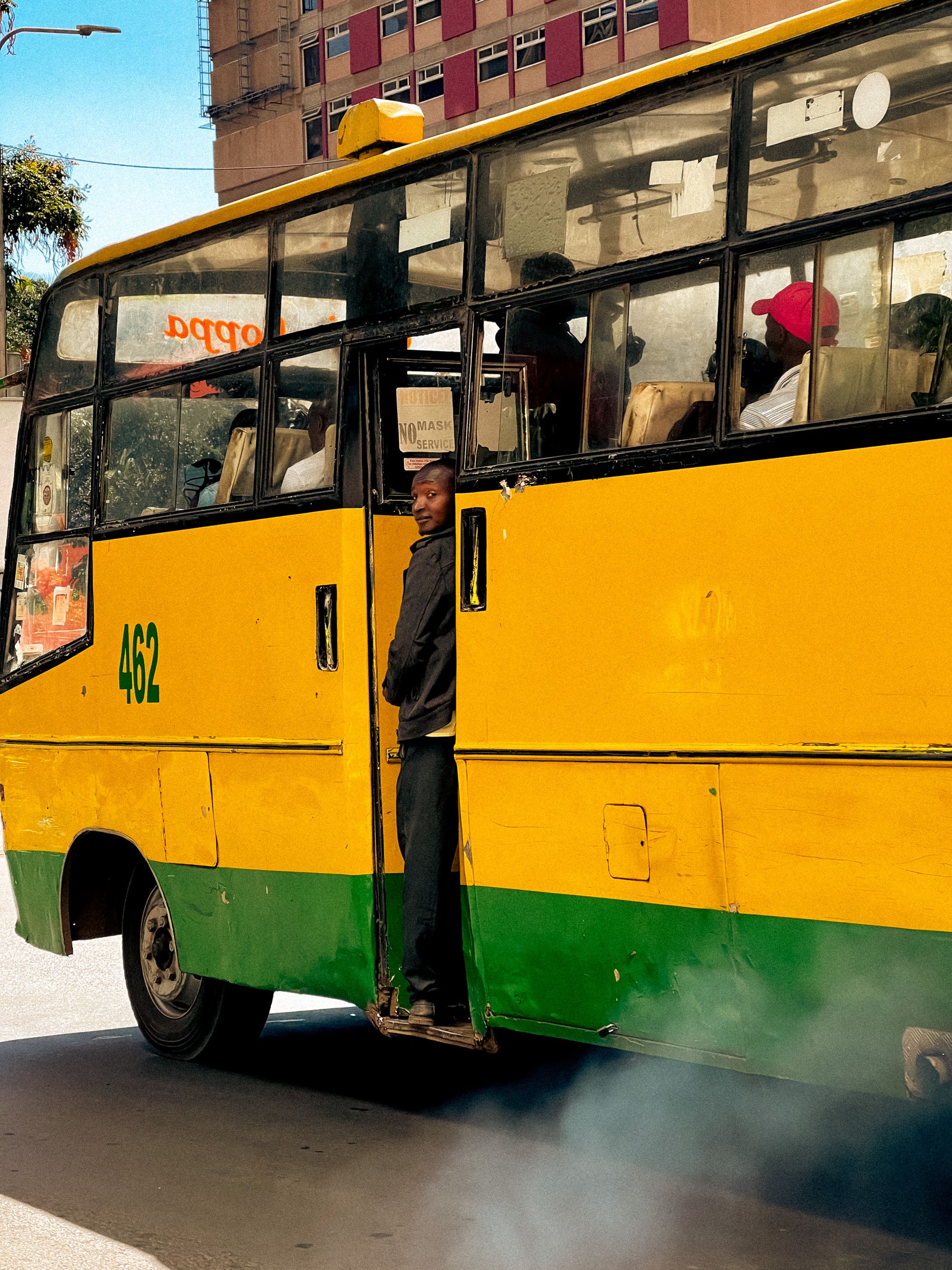
Matatu stages are rarely marked and often shift, yet the system works because the stage is a physical place, not a sign. The vehicles pull to the loaded kerb, the crew knows the route, and the queue forms where the crowd already waits. This page is about reading that place: where it sits, how the line works, who calls the vehicle, and what to ask before you get on. It is not about route numbers, which are painted on the vehicles. The numbers tell you where a matatu is going; the stage tells you where it will stop.
This page treats the stage as the unit of the system. A stage is a stretch of kerb, a corner, a lay-by or a gap outside a building. It has no sign, no timetable and no printed list. It exists because crews and passengers agree on it, day after day. When that agreement changes, because of enforcement, roadworks or a new terminus, the stage moves and the sign, if there ever was one, becomes wrong. The page cannot map the stands, because they move. It can explain what makes a stage legible in the first place.
The reading skill is not complicated, but it is not obvious either. You look for the fixed edges: the corner, the building line, the place where the pavement widens. You look for the queue, which may be a line, a clump or a loose crescent. You listen for the caller, the person who shouts the destination and waves the vehicle in. You watch the turnaround, where a vehicle that has emptied fills again. These four things, taken together, tell you that you are at a stage, even when nothing on the street says so.
This matters because the alternative is guesswork. A visitor who waits on an empty stretch of kerb will wait a long time: vehicles pull to the loaded kerb, not to a lone figure. A visitor who boards the first vehicle that stops without confirming the destination may end up in the wrong part of the city. A visitor who treats every stage as interchangeable will find that the one outside the bank serves a different set of routes from the one around the corner. The stage is the interface, and it rewards a little attention.
02What makes a stage legible
A stage is legible through four things, and none of them is a sign. The first is the fixed edge: the stage attaches itself to something that does not move, a corner, a building entrance, a bus bay, a stretch of kerb where the road widens. The second is the queue, which is less orderly than the word suggests, often a clump or a crescent rather than a line, but which has a shape you can join. The third is the caller, the person who calls the destination, waves the vehicle in and decides who boards. The fourth is the turnaround, the moment when a vehicle empties and fills again, which shows you where the stage actually is.
The fixed edges are the most stable part of the picture. Buildings change tenants, but they rarely move. A stage that sits outside a particular bank or hotel will usually stay outside that building until enforcement or roadworks push it elsewhere. The edge gives you a reference point: if you can name the building, you can name the stage, even if no sign does. When a stage moves, it usually moves along the same kerb or around the nearest corner, because the fixed edges nearby are still the ones people know.
The queue is where the system becomes social. A line is rare; a clump is common. People stand where they expect the vehicle to stop, and that expectation is shared. If you stand where the crowd is already waiting, you are in the right place. If you stand on an empty stretch, you are not. The queue also tells you which direction the vehicle will approach from, which matters when the road is busy and you need to move quickly. Watch where people look, and you will see the approach.
The caller and the turnaround complete the picture. The caller may be a conductor, a tout or simply the loudest person at the kerb. They call the destination, and the vehicle pulls in. The turnaround is the clearest signal of all: a vehicle arrives, empties, waits, fills and leaves. If you can find a turnaround, you have found a stage. If you cannot, look for the queue and the fixed edge. Together they will usually put you within a few metres of the right spot, which is close enough.
The fixed edges
Stages cling to something that does not move: a kerb outside a bank, a corner by a hotel, a stretch of road beside a market. That anchor is the address, and it is what a conductor means when naming the stand.
The queue, such as it is
On busy corridors the crowd thickens along one kerb and thins along the other, and vehicles pull to the loaded side. Read which side of the road the bodies are stacked on before you choose a spot.
The caller
A tout calls the destination, sometimes the route number, sometimes only the estate. The call is louder and faster than anything painted on the body, and it is the working announcement of the stage.
The turnaround
Some stages are places vehicles wait rather than pass. On those the vehicle sits, fills, and leaves when it is full, so the stage is a queue with engines rather than a stop with a timetable.
03What this page cannot tell you
This page cannot tell you which stage serves your route, because the answer changes. Stands move with enforcement, roadworks and the termini projects, and a stage that was outside one building is outside another a year later. A printed stand list would be wrong within months and would be trusted anyway. The honest position is that the stage is a moving target, and the only reliable source is the stage itself. Ask at the kerb, ask the conductor, and treat any diagram you are handed as a starting point rather than a fact.
This page also cannot tell you when to travel. It does not print opening hours, because the stage has none, and it does not print clock times, because the rhythm of a stage is set by the working day rather than by a timetable. Stages are busiest before dawn and after the offices close, quieter in the middle of the day, and different again after dark. The page describes those patterns in words. It does not claim that a stage is safe or busy at any particular hour, because that depends on the street, the light and the day.
The page is compiled from published information and the site's own checks rather than from a visit. Nobody writing it has stood at these kerbs. Opening arrangements, stand allocations and anything that moves week to week are not printed here, because they are set by operators and by enforcement and they change. What is printed is the method: the fixed edge, the queue, the caller, the turnaround. That method is stable even when the stands are not. Use it to read the stage in front of you rather than to predict where a stage will be next year.
Why no map of the stands: stands move. Enforcement, roadworks and the termini projects shift which kerb serves which route, and a stage that was outside one building is outside another a year later. A printed stand list would be wrong within months and would be trusted anyway. Ask at the stage, ask the conductor, and treat any diagram you are handed as a starting point rather than a fact.
The limits are real, but they do not leave you helpless. You can read a stage without a sign, and you can confirm what you have read by asking. The point of this page is not to replace local knowledge but to give you enough structure to ask the right question at the right kerb. If you can find the fixed edge and the queue, and if you can hear the caller, you are already most of the way there. The rest is a short conversation with the conductor before you get on.
- Ask the conductor the destination and the stage name before boarding, and confirm the vehicle is going where you were told before you sit down.
- Stand where the crowd is already waiting rather than on an empty stretch, because vehicles pull to the loaded kerb and not to a lone figure.
- Keep the phone in a pocket and the hands free at a stage, since the crowd at the kerb is where reachable bags and screens are taken.
- Treat any stage after dark as a different place, and move to the avenue or take a car rather than learning a stand in poor light.
Why no map of the stands
Stands move. Enforcement, roadworks and the termini projects shift which kerb serves which route, and a stage that was outside one building is outside another a year later. A printed stand list would be wrong within months and would be trusted anyway. Ask at the stage, ask the conductor, and treat any diagram you are handed as a starting point rather than a fact.
04How to use a stage you do not know
Start by finding the crowd, not the sign. Walk the kerb until you see people waiting in a clump or a line, and stand where they stand. Look for the fixed edge that anchors the stage: a corner, a building entrance, a bus bay. Listen for the caller. If you can hear a destination being shouted, you are at a stage. If you cannot, watch for a vehicle that slows, empties and fills. That is the turnaround, and it is the clearest confirmation that you have found the right place. Do not wait on an empty stretch; vehicles pull to the loaded kerb.
Before you board, ask the conductor the destination and the stage name, and confirm the vehicle is going where you were told before you sit down. Ask the fare at the same time and agree it before you get on, since fares move with the hour and the demand. Keep the phone in a pocket and your hands free at the stage, because the crowd at the kerb is where reachable bags and screens are taken. Stand where the crowd is already waiting rather than on an empty stretch, because vehicles pull to the loaded kerb and not to a lone figure.
Treat any stage after dark as a different place. The crowd thins, the light changes and the risk profile changes with it. If you do not know the stand well, move to the avenue or take a car rather than learning it in poor light. That is not a comment on any particular street; it is a rule for a system that has no signs and no timetable. The stage you learned in daylight is not the same stage at night, even if it is the same kerb. Plan to arrive before dark, or plan not to use that stage.
Finally, treat every answer as provisional. The stage you learn this month may move next month, and the queue you join today may form somewhere else tomorrow. That is not a flaw in the system; it is how the system works. The method, not the map, is what you carry: find the fixed edge, join the queue, listen for the caller, watch the turnaround, and ask before you board. Do that, and an unsigned stage becomes usable. Do it once, and you will read the next one faster.
Where this page comes from
Desk research, not fieldwork. Nobody writing this stood on the corner with a stopwatch, and a page that implied otherwise would be the least trustworthy thing on the site. The specifics above came from here:
- Matatu routes and stage locations: Digital Matatus published route data for Nairobi.
- Matatu network: published transport research on Nairobi’s informal routes, which is where any route description here comes from.
- Street-level safety guidance: current travel advisories for Nairobi, checked against the operator advice given at the stages.
Opening hours, ticketing and market days change. No hotel or operator pays to appear here.
05Questions
How do I know I am at the right stage?+
Ask. The conductor calling the destination is the stage's announcement, and a nearby trader or kiosk keeper will point you to the stand for a given route. Confirm before boarding that the vehicle is going where you were told, and get off if it is not.
Why are the stages not signposted?+
The network grew informally and the stands have moved with enforcement and with the termini projects, so paint and posts would be out of date quickly. The route numbers are painted on the vehicles instead, which travel with the route.
Can I take a matatu from River Road after dark?+
This site says plainly that the working stages around River Road are a daytime proposition and not an after-dark one. The stages wind down, the lighting is patchy, and the risk profile changes. Take a car after dark instead.
Is the fare fixed?+
The fare is set by the operator and by the crew, and it moves with time of day and traffic. Agree it before boarding, and have small notes ready. This site does not print fares because they change and belong to the operator.