01The oldest retail street still retailing
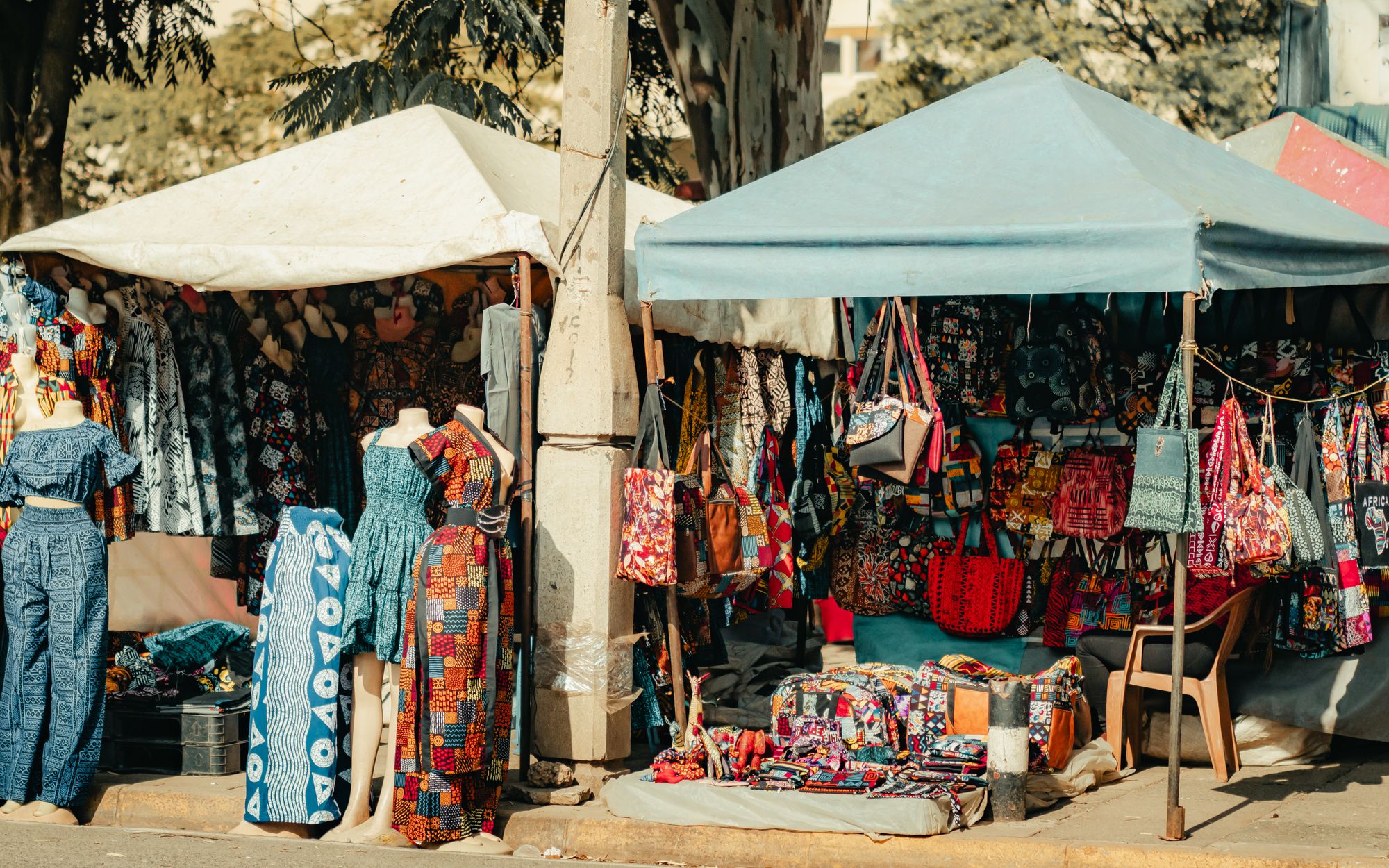
Biashara Street is the oldest retail street in Nairobi still doing what it was built for. Cloth, haberdashery, children's clothes and fabric sold by the metre, one family to a shopfront that is one business wide. It runs north off Kenyatta Avenue, narrow and shaded for most of the day, and it is the single best argument in the centre that a street can keep its purpose for a century. This page covers that block, the City Market hall behind it on Muindi Mbingu Street, and Jamia Mosque at the Banda Street end. It does not cover the malls, the avenue offices or the wider county.
What makes the street worth a page is not the shopping. It is that the scale survived. Almost everywhere else in the central business district, the ground floor has been knocked through, consolidated or handed to a bank. Here the units are still small, the stock is still stacked to the ceiling, and the person behind the counter is usually the person who owns it. Walk the block slowly and you are reading the retail history of the city in its original fabric. Walk it at speed and you will see only cloth shops.
The comparison with the rest of the grid is the point. Two minutes south of the Biashara Street junction, Kenyatta Avenue is towers, banking halls and traffic. Two minutes north, the City Market hall of the 1930s sits under its deck-and-arch roof with produce at the centre and curios in the gallery above. Jamia Mosque closes the block with three silver domes. A quarter that looks incidental on a map holds more architectural history per hundred metres than anywhere else in the centre. That is why this page exists.
Read it as a walking plan, not a shopping list. The advice below covers when to come, what the block is made of part by part, what this page will not claim to know, and how to use the quarter without wasting a morning. It names no trader and no price appears anywhere on this site. The verdict is straightforward: this is the best twenty minutes in the central business district, and it works best on foot in daylight.
02What the block is made of
Treat the quarter as four pieces that sit within a few minutes of each other, and the whole thing becomes easy to plan. The rows below give each piece its character, so the rest of this section can deal with how they fit together rather than repeating what is already written. What matters is the sequence: shops first, market hall second, mosque and library to close. Do not try to do them in a different order and do not treat any one of them as a destination in itself.
The shops on Biashara Street are the reason to come. Single-fronted units, cloth by the metre, haberdashery, school outfitters, and tailors upstairs or next door who will make up what you buy. The stock is deep rather than wide. If you want a specific fabric, ask; do not expect to browse every colour of everything. The trade is wholesale as much as retail, so the shopkeeper is often serving a customer who buys in bulk while you wait. That is normal here, not a slight.
The City Market hall behind is the second piece and it behaves differently. Produce at the centre, a fish counter, flowers at the door on Muindi Mbingu Street, and a gallery of curio stalls around the upper level. Produce is a morning business and the hall empties before the street shops do. Muindi Mbingu carries the flower sellers, busiest when hotels and offices buy. Banda Street runs between Jamia Mosque at one end and the McMillan Memorial Library at the other. It is the quietest good street in the centre.
Jamia Mosque is the piece most visitors get wrong. Built in 1925, it is the principal mosque of the city, and visitors are received outside prayer times with modest dress required. Ask at the gate rather than assuming. The library's marble lions and 1931 reading room are worth the walk if the doors are open. Put together, the four pieces give you cloth, produce, flowers, architecture and a place to sit. That is a full morning, and it does not need a car at any point.
Biashara Street
Fabric, haberdashery and school outfitters, each shopfront the width of one business, with tailors working upstairs. The Swahili name means business, and this has been the street's business for a century.
City Market hall
A 1930s deck-and-arch shed with produce in the nave, a fish counter at the back and curio stalls around an upper gallery. Free to enter, trading through the day and closing in the late afternoon.
Muindi Mbingu Street
The flower sellers cluster at the market door and the produce entrance sits beyond, busiest in the middle of the morning when hotels and offices buy. It runs north beside Biashara Street.
Banda Street
Jamia Mosque at one end, the McMillan Memorial Library behind its marble lions at the other. Built in 1925 and 1931 respectively, it is the quietest good street in the centre.
03What this page will not pretend to know
This page is compiled from published information and the site's own checks, not from a visit. Nobody writing it has stood in the curio gallery or eaten at the market edge. That matters for honesty: opening arrangements and anything that moves week to week are not printed here, because they change and a printed hour would go stale without warning. What follows instead is what holds true regardless of the season, plus the bullet list of practical warnings already set out above. Where certainty is missing, this page says so rather than filling the gap.
The honest half is that the quarter is not comfortable. The pavements are narrow and often blocked by stock, the streets are shaded but also congested, and the curio gallery operates on a bargaining culture that rewards patience and penalises fatigue. If you arrive expecting a calm museum experience, you will be disappointed. If you arrive expecting a working retail quarter that has been working for a century, you will get exactly that. The discomfort is part of the fabric, not a failure of it.
The bullet list above carries the practical warnings in full, so they are not repeated here. What is worth adding is what the list cannot cover: the street changes character through the day and through the week, the produce trade and the cloth trade keep different clocks, and the mosque keeps a third. No single visit can see all of it, and no page can promise which parts will be open when you arrive. Ask at the gate, ask at the shop, and check the current notice at the market entrance before committing to a plan.
The callout below sets out what this page cannot tell you about hours, market days, ticketing and price. Read it before you go. The rest of the advice here is about sequence and timing, which are the two things a reader can actually control. Everything that moves week to week is left to the operators and to the notice boards on the ground, where it belongs. That is a deliberate choice, not an omission, and it is the same choice this site makes on every district page.
- Come in daylight between mid-morning and late afternoon: the halls close in the late afternoon and the shutters follow street by street. By after dark there is nothing open and nothing to stay for.
- Do not drive into this quarter. The streets are narrow, parking is street-side and full, and the whole district is a short walk north of Kenyatta Avenue.
- In the curio gallery, expect the opening figure and the closing figure to sit a long way apart. Walk on, come back, and settle at a number you are content with.
- If you buy cloth, agree the making-up and the timeline inside the shop before leaving it. Turnaround is a matter of days, not hours, and the tailor is usually upstairs or next door.
What this page cannot tell you
Opening hours, market days and ticketing are set by the operators and move with the season, so none are printed here. The same goes for any price: none appears on this site, and fabric sold by the metre, curio figures and tailoring are all agreed in the shop. Check the current notice at the market entrance, at the library door and at the mosque gate, or ask the shopkeeper directly before you commit.
04How to use the quarter well
Come in daylight, between mid-morning and late afternoon. The halls close in the late afternoon and the shutters follow street by street, so an early start buys you the produce trade and a mid-morning start buys you the cloth shops at their busiest and best. By after dark there is nothing open and nothing to stay for. Give the quarter an hour if you are buying nothing, most of a morning if you are buying cloth and having it made up, and longer if you intend to negotiate seriously in the curio gallery.
Do not drive in. The streets are narrow, parking is street-side and full, and the whole district is a short walk north of Kenyatta Avenue. Arrive on foot from the avenue and leave on foot. That single decision removes most of the friction from the visit. Once inside the block, work it as a loop rather than a line: Biashara Street north, the market hall in the middle, Banda Street back south past the mosque and the library. The loop takes in all four rows without retracing and keeps you shaded for most of the way.
In the curio gallery, expect the opening figure and the closing figure to sit a long way apart. That is the custom of the place rather than rudeness in either direction. Walk on, come back, and settle at a number you are content with. If you buy cloth, agree the making-up and the timeline inside the shop before leaving it. Turnaround is a matter of days, not hours, and the tailor is usually upstairs or next door. Get that agreement in the shop, not over the phone later, because the shop is where the tailor is known.
The verdict is simple. This is the best walking quarter in the central business district and it rewards a slow hour more than a fast one. Come in daylight, come on foot, buy the cloth before the curios, and leave the price and the hours to the operator. If you have only one morning in the centre and want to understand how the city traded before the malls, spend it here and nowhere else. Read the bullet list above once before you leave the hotel, then put the page away and walk.
Where this page comes from
Desk research, not fieldwork. Nobody writing this stood on the corner with a stopwatch, and a page that implied otherwise would be the least trustworthy thing on the site. The specifics above came from here:
- City Market and McMillan Library: Nairobi City County heritage listings and the library trust’s restoration notices.
- City Market: Nairobi City County market information.
- Distances and walking minutes: computed from published coordinates, direct line at 4.8 km/h.
Opening hours, ticketing and market days change. No hotel or operator pays to appear here.
05Questions
Can I change money on the avenue?+
The commercial streets around Kenyatta Avenue carry banks and bureaux, and Biashara Street sits a short walk north of them. Rates and opening times are set by each operator and move, so check at the counter rather than relying on any published figure. Bring identification, as counters ask for it.
Is City Market free to enter?+
Entry to the market hall is free and it trades through the day until the late afternoon. Produce is a morning business and the hall empties well before the shops on the street do. Anything bought inside, from produce to curios, is a matter for the stallholder.
How long should I give Biashara Street?+
Twenty minutes covers the street, the market hall and the walk down to Jamia Mosque. Allow longer if cloth is being chosen or made up, since tailoring runs to days rather than hours. The whole quarter is compact, with the shortest distances of any part of the centre.
Can I visit Jamia Mosque?+
The mosque receives visitors outside prayer times and asks for modest dress. Built in 1925 on Banda Street, it is the principal mosque of the city and closes the block to the south. Ask at the gate, since the times it keeps are set by the mosque and not printed here.