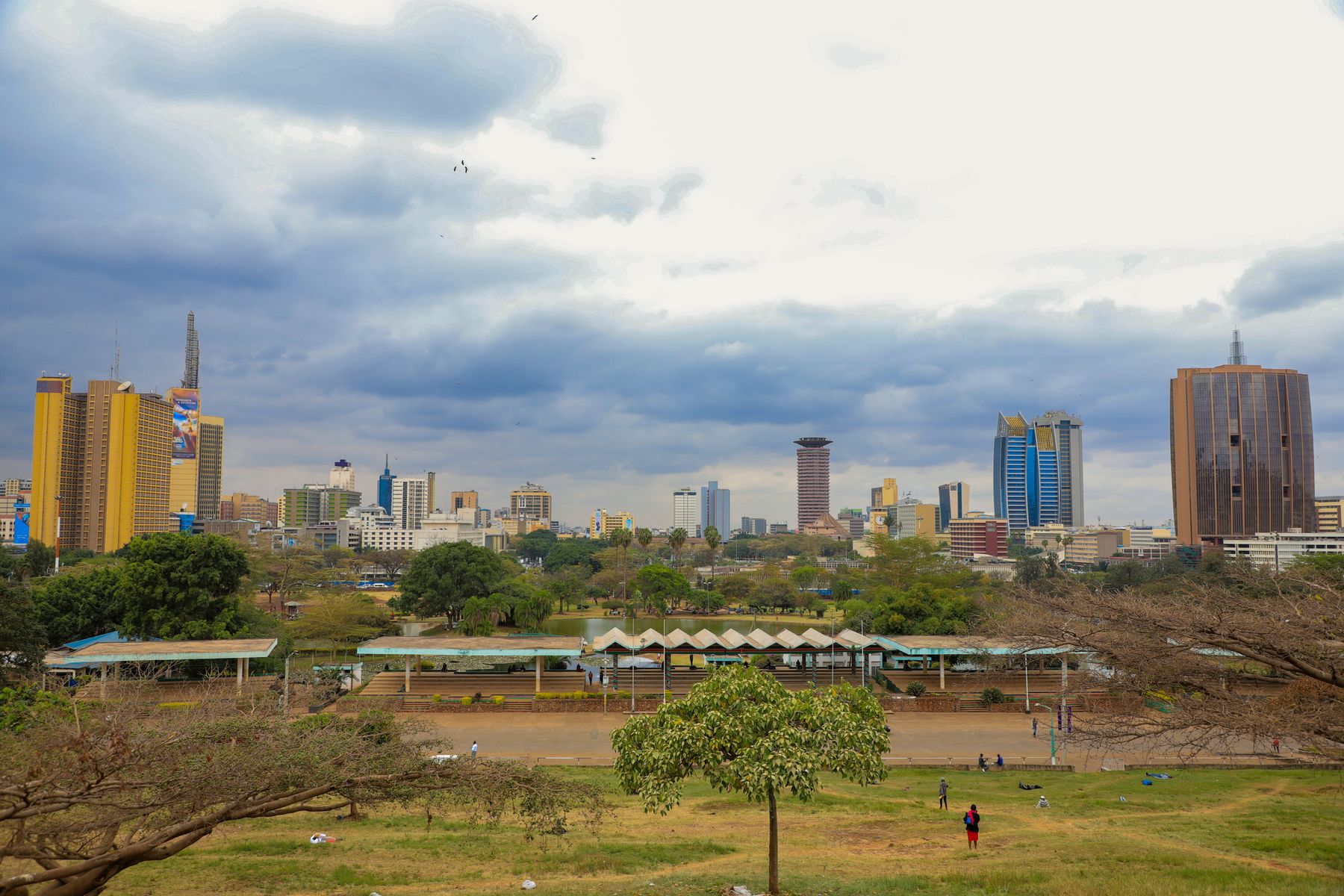
01Start at Parliament Road and the old government quarter
Begin at the corner of Parliament Road and City Hall Way, where the stone-faced Parliament Buildings sit behind a garden of jacarandas that flower from late September into November. Walk south past the City Hall and the law courts, all laid out in the 1950s by British architects working in a stripped classical style. The façades are pale Kenyan stone, the windows tall and regular, and the whole cluster reads as one deliberate composition. It takes twenty minutes to circle, less if you skip the interior courtyards, which are closed to casual visitors anyway.
Continue downhill along Harambee Avenue, where the 1970s government offices give way to the distinctive round tower of the Kenyatta International Convention Centre. The KICC is the centrepiece of the walk: a concrete cylinder with a flared podium, designed by David Mutiso and Karl Henrik Nøstvik and completed in 1973. You can take the lift to the viewing deck on weekdays for a modest fee; the queue is shortest before 10am. From the top, the whole grid of the CBD is visible at once, which makes the rest of the route easier to picture.
02The CBD grid: modernist banks and market halls
Head west on Kenyatta Avenue, which is the best single street for reading Nairobi's post-independence architecture. The tall glass-and-concrete bank towers along it date mostly from the 1980s and 1990s, and several have double-height ground floors with shaded arcades that make walking comfortable even at midday. Cross at the Kimathi Street lights and duck into the covered lanes behind, where smaller office blocks from the 1960s survive with their original mosaic entrances. This is a working commercial district, so expect crowds, hawkers and security checks at building entrances; carry photo ID.
From Kenyatta Avenue, cut north to the City Market on Muindi Mbingu Street, an open-sided hall with a sawtooth roof that has been in more or less continuous use since the 1930s. It is not a formal architectural attraction, but the timber trusses and the scale are worth two minutes. Then walk east along River Road, which is louder, denser and entirely different in character, lined with shophouses and market stalls. I would not linger here in the late afternoon, but mid-morning it is busy and safe enough for a brisk pass-through.
03Upper Hill and the colonial remnants
Cross Haile Selassie Avenue and climb towards Upper Hill, where the gradient gives you a clean view back over the CBD skyline. Along the climb, the Anglican Cathedral of St Stephen on Nairobi's oldest mission ground sits quietly behind a wall; it is a modest 1950s building but the grounds are peaceful and free to enter. Upper Hill itself has become a cluster of new towers, and the contrast between the heavy stone of the lower city and the glass up here is the point of the walk. Allow about forty minutes for the climb and the return.
Finish at the Nairobi Railway Museum on Station Road, a low colonial-era building with rolling stock in the yard, open daily for a small entry fee. The station architecture alongside it dates to the early twentieth century and gives a sense of how the city grew around the railway line. From here, it is a fifteen-minute walk or a short ride back to the hotels clustered around Kimathi Street and Muindi Mbingu Street, which is where I would book — you are inside the walk rather than commuting into it.
04Practical timing and where to stay
Do the walk on a weekday morning, ideally between 8am and 1pm, when offices are open, the light is best on the east-facing façades and the streets are busy without being exhausting. Avoid the last Friday of the month, when the CBD fills for market-day traffic. June to August is cool and dry, which suits the climb to Upper Hill; the long rains in April and May make the pavements slippery and the views hazy. Carry small notes for entry fees, since card machines are unreliable in smaller sites.
For accommodation, the Kimathi Street and Muindi Mbingu Street area puts you within ten minutes of every stop on this route, and the standard mid-range band there runs from about 6,000 to 12,000 shillings a night. Hotels nearer Upper Hill are quieter and newer but add a twenty-minute walk to the start. I would book central, and use the saved time for the KICC deck at opening, which is the single best view in the city.
Where this page comes from
Desk research, not fieldwork. Nobody writing this stood on the corner with a stopwatch, and a page that implied otherwise would be the least trustworthy thing on the site. The specifics above came from here:
- Written for this site by its editor. No outside source is claimed for it.
Opening hours, ticketing and market days change. No hotel or operator pays to appear here.
05Questions
How long does the architecture walk take?+
The full route from Parliament Road to the Railway Museum is about 4.5 kilometres and takes three to four hours at an unhurried pace, including the KICC viewing deck and two short stops. Add an hour if you want lunch in the CBD.
Is the walk suitable for a first-time visitor to Nairobi?+
Yes. It stays on main streets in a busy commercial district and the landmarks are easy to find. Carry photo ID for building security checks, keep valuables out of sight and walk it in daylight hours rather than late afternoon.
When is the best month for this walk?+
June to August offers cool, dry weather and clear views from the KICC deck. September to November brings the jacaranda blooms around Parliament Road. Avoid April and May, when heavy rain makes pavements slippery and the skyline hazy.