01Why this pairing matters
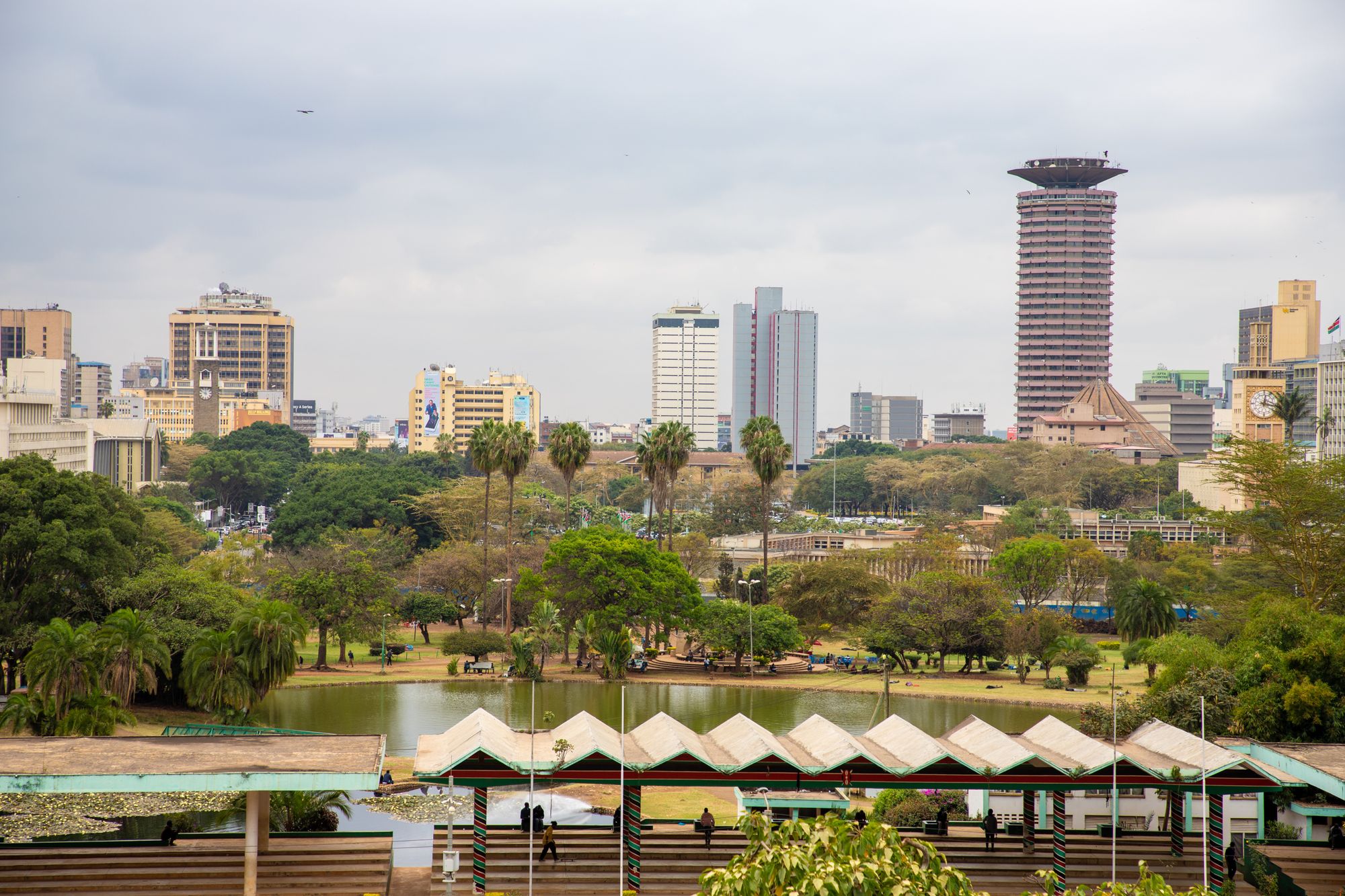
Nairobi's civic block is unusual in one respect that visitors notice immediately and cannot quite name. The Holy Family Basilica, a 1960s hall of pale concrete, stands on the square with its doors facing the paving. Rising directly behind and above it is the Kenyatta International Convention Centre, the twenty-eight-storey cylinder finished in 1973. Nothing separates them. The cathedral and the tower occupy the same view, the same axis, the same photograph. For a district that grew quickly, often awkwardly, this is a rare moment of composition. The pairing is not an accident of later building: it is the clearest single image of how the civic block was arranged, and it is worth a page because it explains the whole quarter at a glance.
The tower was built as the headquarters of the governing party and the country's main conference venue, designed by Karl Henrik Nostvik with David Mutiso. It was never meant to be modest. The basilica came a decade earlier, seating several thousand, a low and generous hall placed deliberately on the square. Put together, the two buildings say what the state wanted from this patch of ground: government, worship, law and ceremony, all facing open paving and all readable from one standing position. You can see the whole argument without moving your feet. That is the reason this page exists, and the reason the square repays a slower look than most people give it.
Most visitors come for the rooftop deck and treat the basilica as an afterthought on the way past. The better reading runs the other way. Look at the cathedral first, from the square, in daylight, and note how low it sits. Then look up. The tower does not crowd it; the two buildings were placed so that the smaller one holds the ground while the larger one takes the sky. That relationship is the thing worth understanding, because it tells you how this district was thought about by the people who laid it out in the 1960s and 1970s. Once you have seen it, the rest of the block, Parliament and the mausoleum, the Supreme Court in the old Law Courts, City Hall, stops looking like a random collection and starts looking like a plan.
There is a practical edge to this as well. The square is the only part of the central grid planned as a set piece rather than allowed to happen, and it is closed to through traffic, so you can stand still without being in anyone's way. Very little in Nairobi's centre offers that. The pairing of cathedral and tower gives you a fixed point in a quarter where almost everything else is traffic, security fencing and office frontages. It is the easiest orientation the district offers: find the tall concrete cylinder, find the low pale hall at its foot, and you have the civic core located on the map. Everything else in the block can be read from there.
02The cathedral and the tower
Take the basilica on its own terms first. It is a hall built for a very large congregation, plain-faced, with a wide entrance facing the square and a roofline kept deliberately low. The restraint is the point. A building this size in most cities would announce itself with a dome or a spire. Here the mass sits close to the ground and lets the paving do the talking. Inside, the volume is generous and the light is even, which is what a hall designed for several thousand people needs. Outside, the pale concrete has weathered in a way that suits the exposed concrete of the tower behind it, so the two buildings share a material language even though they are a decade apart in age and quite different in ambition.
The tower is the louder building and knows it. Twenty-eight storeys of exposed concrete, cylindrical, with a conference amphitheatre gathered at its foot and a helipad on the roof that the public can stand on. It was finished in 1973 to a design by Karl Henrik Nostvik with David Mutiso, and it has been the shorthand for Nairobi ever since. From the square, the cylinder rises almost directly above the basilica's roof, which is why the pairing reads so strongly from the paving: one vertical, one horizontal, both in the same pale grey, both facing the same open space. The tower deck is the reason most visitors come into this quarter at all. Understand that the view from the deck and the view of the deck are two different things, and the second one is available to anybody standing on the square.
The square between them is what makes the relationship legible rather than merely close. It is open paving, closed to vehicles, with the mausoleum of the first president on the Parliament side and the civic frontages arranged around the edges. Because nothing is allowed to park or push through, you get an uninterrupted sightline from the basilica doors to the base of the tower and back again. That is rare anywhere in the central business district, where the ordinary condition is a narrow pavement beside moving traffic. The square is also, by common agreement, the best walking surface in the centre: flat, generous, and free of the hawker pressure that builds on the surrounding streets. Use it as a room to stand in, not just a route across.
The view from the deck closes the circle. From the roof, the tower's own quarter flattens out below you, the square becomes a recognisable shape, and the basilica's low roof sits at the middle of it like a held note under the cylinder. This is the vantage that ties the two buildings together in a single frame, and it is the reason the pairing is not just a ground-level impression. The deck is reached by a lift most of the way and a short stair, identification is asked for at the desk, and the light is best for the view north and west earlier in the day. Go up if the deck is open, but walk the square first, because the square is what explains the tower.
The basilica itself
Holy Family Basilica is a pale concrete hall built in the 1960s for several thousand people. It faces the square directly, between services, and is often empty on a weekday afternoon.
The tower above it
The 1973 conference centre is a 28-storey cylinder in exposed concrete, with an amphitheatre roof and a helipad deck. It stands behind and above the basilica, so the pairing is vertical as much as it is face to face.
The square between
Open paving, flags and no through traffic. This is the only place in the civic block where you can stand still without being in someone's way, and it is what makes the two buildings read together.
The view from the deck
A ticket at the ground-floor desk, a lift most of the way and a short stair to the helipad. From up there the basilica is a pale rectangle below the tower's shadow, which is the relationship you came to see.
03What this page cannot tell you
The honest half of this page is the shorter half, and it is the part that matters most. The basilica, the tower deck and the gallery spaces around the square all keep hours of their own. Those hours are set by the operators, they change, and the deck in particular can close for state events without notice. This page therefore prints no opening or closing time for any of them, and it does not print a day of the week, a market day or a season. Any hour you read elsewhere, including on a sign, is a thing that moves. The arrangement of the buildings is fixed. The access to them is not, and no page can fix it for you.
This page is compiled from published information and the site's own checks rather than from a visit. Nobody writing here has stood on the square, timed the walk from Kenyatta Avenue, or queued at the conference centre desk. What is written about the buildings, their dates, their designers and their arrangement, comes from the public record. What is written about what you will find on the day is deliberately thin, because it is the part that cannot be verified from a desk. Treat the fixed things here, the placement of the two buildings and the shape of the block, as reliable, and treat anything that moves week to week as something to confirm in person.
Opening arrangements and anything else that shifts from week to week are not printed here for that reason. That includes whether the basilica is open between services on the day you arrive, whether the deck is running, whether a state event has closed the square, and whether the gallery spaces are between exhibitions. The practical rule is simple: ask at the door you want to enter. Ask at the basilica door about the hours between services. Ask at the conference centre desk about the deck and about identification. Ask before photographing anywhere near Parliament and the ministries, because security there is real and the answer changes.
There are two further gaps worth naming. The first is cost: no ticket, fare or entry figure belongs on this page, and none is printed. Where a cost matters, the question is what to ask and where to ask it, not what the number is. The second is timing. No clock time is given for anything on this page, because a printed hour becomes a false promise the moment an operator changes it. If you need a time of day, work in words: before dawn for an empty square, early morning for the clearest light on the tower, the middle of the day for shade and crowds, mid-afternoon for a quiet basilica, after dark for a lit and empty civic block. That is the most this page can honestly offer.
- Walk three minutes from Kenyatta Avenue, because vehicles are kept off the square and the approach on foot is the sensible one.
- Expect the tower deck to close without notice for state events, and ask at the desk rather than turning up assuming it is open.
- Take identification for the rooftop, since it is requested at the desk, and go in daylight when the view north and west is clearest.
- Ask before photographing around Parliament and the ministries, or keep the camera down along Harambee Avenue where security is real.
Why no hours are printed
The basilica, the tower deck and the gallery spaces keep hours of their own, and the deck can close for state events without notice. This page therefore prints no opening or closing time for any of them. Ask at the basilica door, ask at the conference centre desk, and treat any hour you read elsewhere as a thing that moves. The arrangement of the buildings is fixed; the access to them is not.
04What to do with it
Give the square a proper hour rather than a passing glance. Arrive on foot from Kenyatta Avenue, which is the sensible approach because vehicles are kept off the square, and start at the basilica doors facing the paving. Stand there, look up at the cylinder above the low roof, and let the arrangement settle before you do anything else. Then walk the block properly: the Parliament frontage on one side, the Supreme Court and City Hall on the others, the mausoleum on the Parliament side, all around the open paving. The buildings are close together and the whole circuit is short. The point is not distance covered but noticing how deliberately the pieces were placed.
Decide before you arrive whether the rooftop is part of the plan. If it is, allow for the fact that the deck can close without notice for state events and for weather, so ask at the ground-floor desk rather than turning up assuming it is running. Take identification, since it is requested at the desk, and go in daylight when the view north and west is clearest. If the deck is shut, the page's verdict is that you have lost very little: the pairing that makes this quarter worth the detour is visible from the ground, on the square, without a lift. The rooftop adds the view of the quarter. The square adds the understanding of it.
Keep the camera up on the square and the rooftop, and down along Harambee Avenue. Photography on the square and from the deck is expected and unremarkable. Around Parliament and the ministries it is not, and the ministries' street carries real security, so ask first or put the camera away. Practicalities worth carrying: the square is institutional and empties after the offices close, so daylight suits the walking and a car suits the evening, when the district is lit, open and empty with nothing trading. Food in the immediate block runs to conference hotels and the convention centre and thins out when the halls are quiet, so the connectors off Kenyatta Avenue, a short walk north, are the more dependable option on a quiet day.
The verdict is straightforward. This page would send a first visit to the square on foot, in daylight, before anything else in the civic block, and would treat the basilica-and-tower pairing as the centrepiece rather than a backdrop to the lift. If the deck is open and the day is clear, go up afterwards, once the ground-level view has done its work. Ask at the doors, take identification, keep the camera sensible near the ministries, and do not chase a printed time for anything, because none is given here on purpose. What you are being sent to see is fixed: a low pale hall with a concrete cylinder standing directly above it, on the one open square in the centre of Nairobi.
Where this page comes from
Desk research, not fieldwork. Nobody writing this stood on the corner with a stopwatch, and a page that implied otherwise would be the least trustworthy thing on the site. The specifics above came from here:
- Building history and public access: Kenyatta International Convention Centre visitor information.
- Holy Family Basilica: Archdiocese of Nairobi parish information.
- KICC: Kenyatta International Convention Centre, visitor information.
Opening hours, ticketing and market days change. No hotel or operator pays to appear here.
05Questions
Is the basilica open to visitors between services?+
It usually is, and the middle of a weekday is when it is quietest. The parish keeps its own arrangements, so ask at the door rather than relying on any printed hour. Services take priority over visitors, as they should.
Can I see the tower from the square without buying a ticket?+
Yes. The square is open paving and the tower is visible from it. The ticket is for the rooftop deck, which is bought at the ground-floor desk, and the desk is the place to ask whether the deck is open that day.
How do the two buildings relate to each other?+
The basilica faces the square and the tower rises behind it, so the pairing is both face to face and vertical. The square is what makes the relationship legible: stand in the middle and both are in front of you.
Is it worth going up the tower as well as walking the square?+
The square is the reason the pairing reads at all, so walk it first. The deck adds the view from above, where the basilica becomes a pale shape under the tower's shadow. Whether to add the deck is a judgement about your own time and head for heights.